Showing posts with label Nikon. Show all posts

6 Oct 2011

TOP15 Nikon microscope photos Small World Contest 2011

A photomicrograph is a technical document that can be of great significance to science. A one is also an object of beauty, open to several levels of appreciation. And once a year, Nikon celebrates the best of the bunch.
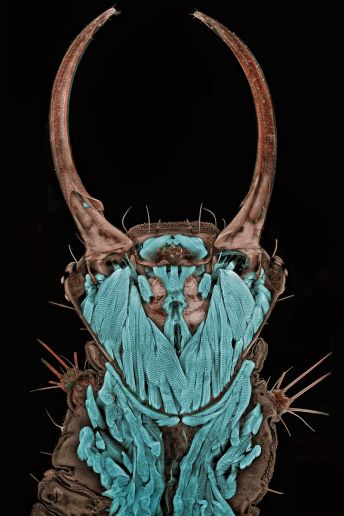
1st Place -- Dr. Igor Siwanowicz
Portrait of a green lacewing larva
Technique: Confocal, magnified 20X
Source: Dr. Igor Siwanowicz/Max Planck Institute of Neurobiology
2nd Place -- Dr. Donna Stolz
Blade of grass
Technique: Confocal stack reconstruction, autofluorescence, magnified 200X
Source: Dr. Donna Stolz/University of Pittsburgh
3rd Place -- Frank Fox
Melosira monoliformis (living specimen)
Technique: Differential interference contrast, magnified 320X
Source: Frank Fox/Fachochschule Trier
4th Place -- Dr. Robin Young
Liverwort
Technique: Live mount, confocal microscopy, magnified 20X
Source: Dr. Robin Young/University of British Columbia
5th Place -- Alfred Pasieka
3D reconstruction of a microchip
Technique: Incident light, Normarski interference contrast, magnified 500X
Source: Alfred Pasieka
6th Place -- Dennis Callahan
Cracked solar cell films
Technique: Brightfield, magnified 50X
Source: Dennis Callahan/California Institute of Technology
7th Place -- Gabriel Luna
Nerve fibers from the retina of a mouse
Technique: Laser confocal scanning, magnified 40X
Source: Gabriel Luna/UC Santa Barbara, Neuroscience Research Institute
8th Place -- Dr. Bernardo Cesare
Coarse-grained rocks bearing graphite
Technique: Polarized light, magnified 2.5X
Source: Dr. Bernardo Cesare/Department of Geosciences
9th Place -- Dr. Jan Michels
The underbelly of a marine copepod
Technique: Confocal, autofluorescence and congo red fluorescence, magnified 10X
Source: Dr. Jan Michels/Christian-Albrechts-Unversitat zu Kiel
10th Place -- Joan Rohl
Freshwater water flea
Technique: Differential interference contrast, magnified 100X
Source: Joan Rohl/Institute for Biochemistry and Biology
11th Place -- Dr. Jan Michels
Front view of an ant head
Technique: Confocal, autofluorescence, magnified 10X
Source: Dr. Jan Michels/Christian-Albrechts-Universitat zu Kiel
12th Place -- Thomas Deerinck
"Immortal" cancer (HeLa) cells
Technique: 2-Photon fluorescence, magnified 300X
Source: Thomas Deerinck/National Center for Microscopy and Imaging ResearchV
13th Place -- Dr. Stephen S. Nagy
A cross-section of a curare vine
Technique: Brightfield, digitally inverted, magnified 45X
Source: Dr. Stephen S. Nagy/Montana Diatoms
14th Place -- Yanping Wang
Various grains of sand
Technique: Reflected light, magnified 4X
Source: Yanping Wang/Beijing Planetarium
15th Place-- James H. Nicholson
A live specimen of lobe coral, its tissue pigmented with red fluorescence
Technique: Epiflurescence with triple band (U/B/G) excitation, magnified 12X
Source: JAmes H. Nicholson/Coral Culture and Collborative Research Facility
»»  read more

25 Aug 2011

Nikon Coolpix L24/Review


The good: The Nikon Coolpix L24 is an affordable, easy-to-use compact with a 3-inch LCD that produces photos with pleasing color under the right conditions.
The bad: The L24 has a mediocre lens, fewer shooting options than competing models, too little control over results, and slow shooting performance.
The bottom line: For easy automatic snapshots of still subjects in good lighting, the Nikon Coolpix L24 is sufficient. If you need more than that, don't bother.
The Nikon Coolpix L24 is nearly identical to the model it replaces, the Coolpix L22. The only difference is a resolution bump from 12 megapixels to 14 megapixels. The rest of the camera remains the same: easy to use with a 3-inch LCD and AA batteries for power. Pop in its batteries and the camera has a nice weight to it making it feel like a sturdy, well-built camera. And, like most in its class, the L24 is very much a fully automatic point-and-shoot with little to adjust except for maybe picking an appropriate scene mode.
However, like the L22, the L24 is a little too crippled in the feature department, which can make it difficult to get usable photos under certain conditions. Team that with a mediocre lens and some performance concerns, and you have an entry-level camera that's not good for much beyond taking snapshots of portraits and landscapes in full sunlight for use at small sizes or online--regardless of its 14-megapixel resolution.
Key specs
Nikon Coolpix L24
Price (MSRP)
$119.99
Dimensions (WHD)
3.9 x 2.4 x 1.2 inches
Weight (with battery and media)
6.5 ounces
Megapixels, image sensor size, type
14 megapixels, 1/2.3-inch CCD
LCD size, resolution/viewfinder
3-inch LCD, 230K dots/None
Lens (zoom, aperture, focal length)
3.6x, f3.1-6.7, 37-134mm (35mm equivalent)
File format (still/video)
JPEG/Motion JPEG (.AVI)
Highest resolution size (still/video)
4,320x3,240 pixels/ 640x480 at 30fps
Image stabilization type
Electronic
Battery type, CIPA rated life
AA (2; alkaline, lithium ion, NiMH), 220 shots (alkaline)
Battery charged in camera
No
Storage media
SD/SDHC
Bundled software
Software Suite for Coolpix (Windows/Mac)


The L24 has an ISO sensitivity range from 80 to 1600, but you have no control over ISO settings--it's auto only. If your subject is in the center of the frame and you have plenty of light so that the sensitivity stays below ISO 400, you can get good photos from the camera. For most of my indoor test shots without a flash, the camera selected ISO 400 and very slow shutter speeds. (In fact, when shooting in the camera's Easy Auto mode it would frequently do this instead of using the flash.) The results are predictably mediocre, soft and smeary with color issues from noise. The camera also struggles with focusing in dim lighting doing a lot of hunting and there's a noticeable shutter lag. If you're considering the L24 to use indoors without a flash, don't. Should your subject move, you have shaky hands, or both, you'll likely end up with blurry shots unless you use the flash. This camera is really only good for stills of stationary subjects under bright lighting, preferably outdoors.


Colors are pleasing from the L24 (and probably the best thing about this camera's photos). It seems to pump up some reds and blues, but otherwise, subjects were bright and natural. However, that changes as more noise is introduced at higher ISO sensitivities. The auto white balance is somewhat yellow-green under fluorescent light and warm under incandescent. Oddly enough there is a manual white balance that works really well, but it's only available in Auto mode.
Video quality is good enough for Web use, but not much else. The zoom lens does not function while recording, but you do have a digital zoom; I suggest not using it, as the results are unpleasant. Also, bright scenes are full of colored streaks called smear, which is caused when bright light hits the image sensor.
Conclusion
There is definitely a market for cameras like the Nikon Coolpix L24. It's cheap, it's easy to use, and it takes AA-size batteries. You really shouldn't expect much more than that for its sub-$120 price. However, you can get more than the L24 offers. For example, at less than $110 you can pick up Canon's PowerShot A1200 and get a wider lens and an optical viewfinder, more shooting features, and better photos and video, and it's just as easy to use.
»»  read more
Related Posts .