Showing posts with label discoveries. Show all posts

6 Dec 2011

largest black holes discovered by scientists

Scientists have discovered the largest black holes yet, and they're far bigger than researchers expected based on the galaxies in which they were found.
An artist's rendition of a mammoth black hole, NASA
The discovery suggests we have much to learn about how monster black holes grow, scientists said.

All large galaxies are thought to harbor super-massive black holes at their hearts that contain millions to billions of times the mass of our sun. Until now, the largest black hole known was a mammoth dwelling in the giant elliptical galaxy Messier 87. This black hole has a mass 6.3 billion times that of the sun.
Now research suggests black holes in two nearby galaxies are even bigger.

The scientists used the Gemini and Keck observatories in Hawaii and the McDonald Observatory in Texas to monitor the velocities of stars orbiting around the centers of a pair of galaxies. These velocities reveal the strength of the gravitational pull on those stars, which in turn is linked with the masses of the black holes lurking there.

The new findings suggest that one galaxy, known as NGC 3842, the brightest galaxy in the Leo cluster of galaxies nearly 320 million light years distant, has a central black hole 9.7 billion solar masses large. The other, named NGC 4889, the brightest galaxy in the Coma cluster more than 335 million light years away, has a black hole of comparable or larger mass. Both encompass regions or "event horizons" about five times the distance from the sun to Pluto.

Astronomers had suspected that black holes more than 10 billion solar masses large exist, based on light from quasars, cosmic objects from the early universe that are no more than a light year or two across but are thousands of times brighter than our entire galaxy.

The light of quasars is thought to come from matter driven to incandescent brightness as it spirals at high speeds into supermassive black holes. This is the first time scientists have detected black holes approaching such theorized giants in size.

This pair of black holes is 1.6 to 4.6 times more massive than one would predict from their galaxies, based on details such as the brightness of the bulges at their centers. These findings suggest that black holes may grow differently in large galaxies than in small ones.
»»  read more

Planet similar to Earth discovered: NASA

This artist's conception illustrates Kepler-22b, a planet known to comfortably circle in the habitable zone of a sun-like star. It is the first planet that NASA's Kepler mission has confirmed to orbit in a star's "habitable zone" -- the region around a star where liquid water, a requirement for life on Earth, could persist.
NASA announced the discovery of another planet close enough to the sun it orbits to potentially support life.
Called Kepler-22b, about 2.4 times the radius of Earth and about 600 light-years away. And it orbits in the "habitable zone," the region of space just far enough from a star that liquid water could exist on the planet's surface -- a discovery could have profound implications in the quest for alien life, said Alan Boss, an astrophysicist with Carnegie Melon University.
The host star lies about 600 light-years away from us (1 light year is about 6 trillion miles) toward the constellations of Lyra and Cygnus, the researchers said, and is about 25 percent less luminous than the Sun. Kepler-22b orbits the star every 290 days, as compared with 365 days for the Earth, at a distance about 15 percent closer to its star than the Earth from the Sun -- close enough to suggest a pleasing, balmy temperature on the surface.

The planet is  in the middle of what astronomers call the Goldilocks zone, that hard to find place that's not too hot, not too cold, where water, which is essential for life, doesn't freeze or boil and this new planet might well be not only habitable but perhaps even inhabited.
The discovery team, led by William Borucki of the NASA Ames Research Center, pored over photometric data from the NASA Kepler space telescope. They watched for tiny dimmings of star light -- dimmings that can only be measured by a highly specialized space telescope like Kepler -- which indicate that an Earth-size planet is transiting between us and a star.
So far the Kepler telescope has spotted 2,326 candidate planets outside our solar system with 139 of them potentially habitable ones. Even though the confirmed Kepler-22b is a bit big, it is still smaller than most of the other candidates. It is closest to Earth in size, temperature and star than either of the two previously announced planets in the zone.
Of the 54 habitable zone planet candidates spotted in February 2011, Kepler-22b is the first to be confirmed.
»»  read more

3 Dec 2011

World's Oldest Tiger Species Discovered

The extinct Longdan tiger (Panthera zdanskyi) was a jaguar-sized tiger that lived in what is now northwestern China more than 2 million years ago. Shown here, an artist's reconstruction of the tiger.
CREDIT: Velizar Simeonovski et al, PLoS ONE


The oldest extinct species of tiger known yet has been discovered in China, scientists say.

Although the skull of the more than 2-million-year-old fossil is smaller than most modern tigers, it appears very similar in shape, researchers added.

The tiger (Panthera tigris) is one of the largest living cats, a giant predator native to Asia reaching up to 13 feet (4 meters) in length, including its tail, and weighing up to 660 pounds (300 kilograms). The beast's origins are under intense debate, with suggestions it arose in north-central China, southern China or northern Siberia.
Now scientists have discovered a new skull and jaw from an extinct jaguar-sized tiger in northwestern China dating back 2.16 million to 2.55 million years, predating other known tiger fossils by up to a half-million years. This represents the oldest complete skull hitherto found of a pantherine cat — the lineage that includes tigers and all other living big cats.

"The discovery of the identity of this fossil is vitally important for providing a greater understanding of the fossil history of big cats and the relationships between them," said researcher Andrew Kitchener, principal curator of vertebrate biology at National Museums Scotland in Edinburgh.
The scientific name for this newfound species is Panthera zdanskyi, after the late Austrian paleontologist Otto Zdansky, who revealed much about ancient Chinese fossil carnivores. It was unearthed in 2004 on the eastern slope of Longdan, a village in Gansu, China, giving it the informal name of the Longdan tiger. The cat was only recently analyzed and described online Oct. 10 in the journal PLoS ONE.

The skull of this extinct cat had robust, well-developed upper canine fangs and a relatively long nose, details typical of tigers. Although the size of the skull is comparable with that of the smallest females of living tiger subspecies, its overall shape suggests it belonged to a male. Indeed, despite about 2 million years of separation, the skull of the Longdan tiger appears surprisingly similar to that of modern tigers.
"It seems likely that this tiger's diet would have been similar to that of today's and would have included ungulates such as deer and pigs,"Kitchener told LiveScience.
The skull of this extinct cat had robust, well-developed upper canine fangs and a relatively long nose, details typical of tigers. CREDIT: J.H. Mazak et al, PLoS ONE
The researchers suggest this extinct cat was a sister species to the modern tiger. Their analysis argues that the tiger lineage developed features of its skull and upper teeth early on, while its lower jaw and teeth evolved at a different rate. A similar pattern of "mosaic evolution" is seen in the cheetah lineage, they noted. The evolutionary trend of increasing size in the tiger lineage is likely coupled its prey evolving larger body sizes, the researchers added.

"It will be interesting to see whether further fossil big cats are discovered in China and elsewhere, which expand our knowledge of the distribution of this species and fill in more gaps in the tiger's fossil history," Kitchenersaid. "Confirming a more precise dating of Panthera zdanskyi would also be invaluable for understanding its position in the tiger's evolutionary timescale."
--------------------------------
Via LiveScience
»»  read more

30 Nov 2011

Stonehenge Reveals New Clues of Ancient Worship

Image: Stonehenge at sunset. (Credit: Jeffrey Pfau/Wikimedia Commons).
Stonehenge may have been a place for sun worship long before the iconic stones were erected more than 5,000 years ago, according to archaeologists who are carrying out the biggest-ever virtual excavation.
Using noninvasive technologies such as ground-penetrating radar and geophysical imaging, a team from the University of Birmingham's IBM Visual and Spatial Technology Centre, known as VISTA, and the Ludwig Boltzmann Institute for Archaeological Prospection and Virtual Archaeology in Vienna, discovered evidence of two huge pits positioned on a celestial alignment at Stonehenge.

Measuring more than 16 feet across and at least 3 feet deep, the pits lie within the Cursus, a large enclosure north of Stonehenge, which predates the prehistoric monument by up to 500 years.
"This is the first time we have seen anything quite like this at Stonehenge," said project leader Vince Gaffney, an archaeologist from the University of Birmingham.

"When viewed from the Heel Stone, a rather enigmatic stone which stands just outside the entrance to Stonehenge, the pits effectively mark the raising and setting of the sun at midsummer days," he explained.
According to the archaeologists, the pits may have contained tall stones, wooden posts or even fires to mark the sun rising and setting. Most likely, they defined a processional route used to celebrate the passage of the sun across the sky at the summer solstice.

"It is possible that processions within the Cursus moved from the eastern pit at sunrise, continuing eastwards along the Cursus and, following the path of the sun overhead, perhaps back to the west, reaching the western pit at sunset to mark the longest day of the year," said Gaffney.
The hypothesis gained more weight when the researchers measured the walking distance between the two pits.

They discovered that the procession would reach exactly halfway at midday, when the sun would be directly on top of Stonehenge.
"This is more than just a coincidence, indicating that the exact length of the Cursus and the positioning of the pits are of significance," said Henry Chapman, senior lecturer in archaeology and visualization at the University of Birmingham.

According to the researchers, the presence of the pits within the Cursus suggest that the Stonehenge area, which features England's densest complex of Neolithic and Bronze Age monuments, was already sacred before construction work began to build the enigmatic stone circle.
"Even though Stonehenge was ultimately the most important monument in the landscape, it may at times not have been the only, or most important, ritual focus," said Gaffney.

"The area of Stonehenge may have become significant as a sacred site at a much earlier date. Other activities were carried out at other ceremonial sites only a short distance away," he continued.
The researchers have already found a henge-like monument, several other small monuments, and a new horseshoe arrangement of large pits northeast of Stonehenge, which may have also contained posts.
They believe that these structures functioned as minor shrines, perhaps serving specific communities visiting the ceremonial center.

The team is confident that the project will produce new discoveries soon.
"Our knowledge of the ancient landscapes that once existed around Stonehenge is growing dramatically as we examine the new geophysical survey results," said Paul Garwood, a lecturer in prehistory at the University of Birmingham.

"We can see in rich detail not only new monuments but entire landscapes of past human activity, over thousands of years, preserved in subsurface features such as pits and ditches."
DISCOVERY NEWS
»»  read more

23 Nov 2011

First known night-flowering orchid discovered

Botanists have discovered the first known species of orchid that flowers at night, London's Kew Gardens announced on Tuesday. Bulbophyllum nocturnum, found on the island of New Britain near Papua New Guinea, has flowers that consistently open after dark and close in the morning, the only orchid with those characteristics known to science, the Royal Botanic Gardens said.
Bulbophyllum nocturnum
Bulbophyllum nocturnum, found on the island of New Britain near Papua New Guinea, has flowers that consistently open after dark and close in the morning, the only one with those characteristics amongst the 25,000 orchid species known to science, the Royal Botanic Gardens said.
The flowers last for one night only, a habit which initially foxed researchers who could not understand why the buds all appeared to wither once they had seemingly reached the size at which they should open.
Wanting to get to the bottom of this, Dutch researcher Ed de Vogel took the plant home with him one evening in order to find out exactly what happened to the buds.
"To his surprise, the bud that was then present opened up at ten in the evening, long after dark, revealing the flower of an undescribed species," a Kew Gardens spokesman said.
The orchid initally foxed researchers who could not understand why the buds all appeared to wither once they had seemingly reached the size at which they should open.
Observations on subsequent buds confirmed that they all opened around 10pm, and closed the next morning around 10am. The flowers lasted only one night, which explained why the buds were seemingly about to open one day and withered the next.
Kew orchid specialist, Andre Schuiteman, and Bulbophyllum expert Jaap Vermeulenof the Netherlands Centre for Biodiversity Naturalis, then teamed up with de Vogel to investigate and describe the new species.
“This is another reminder that surprising discoveries can still be made," Schuiteman said.
"But it is a race against time to find species like this that only occur in primeval tropical forests. As we all know, such forests are disappearing fast. It is therefore increasingly important to obtain funding for the fieldwork required to make such discoveries.”
Why Bulbophyllum nocturnum has adopted a night flowering habit is unknown and requires further investigation. However, it may be speculated that its pollinators are midges that forage at night, the Kew sookesman said.
Flowers that open only at night are seen in a relatively small number of plant species, such as the queen of the night cactus, the midnight horror tree and night blooming jasmine, but never been documented amongst orchids.
Many orchids are pollinated by moths, but have flowers which remain open during the day even though they are mainly pollinated after dark.
The new species belongs to a group of plants which are known for their bizarre flowers, which variously resemble leggy insects, small hairy spiders to intricate sea creatures and often have thin filaments which make them move erratically in the breeze - possibly to attract insects.
Kew Gardens will stage an orchid festival from February 4 to March 4 next year.
(c) 2011 AFP
------------------------------------------------------------------------------------------------------
»»  read more

18 Nov 2011

World's 'lightest material' unveiled by US engineers


The metallic micro-lattice on a dandelion head Engineers say the material is less dense than aerogels and metallic foams
Engineers say the material is less dense than aerogels and metallic foams
A team of engineers claims to have created the world's lightest material.
The substance is made out of tiny hollow metallic tubes arranged into a micro-lattice - a criss-crossing diagonal pattern with small open spaces between the tubes.

The researchers say the material is 100 times lighter than Styrofoam and has "extraordinarily high energy absorption" properties.
Potential uses include next-generation batteries and shock absorbers.
The research was carried out at the University of California, Irvine and HRL Laboratories and is published in the latest edition of Science.
"The trick is to fabricate a lattice of interconnected hollow tubes with a wall thickness 1,000 times thinner than a human hair," said lead author Dr Tobias Schaedler.

The resulting material has a density of 0.9 milligrams per cubic centimetre.
By comparison the density of silica aerogels - the world's lightest solid materials - is only as low as 1.0mg per cubic cm. The metallic micro-lattices have the edge because they consist of 99.99% air and of 0.01% solids.

The engineers say the material's strength derives from the ordered nature of its lattice design.
By contrast, other ultralight substances, including aerogels and metallic foams, have random cellular structures. This means they are less stiff, strong, energy absorptive or conductive than the bulk of the raw materials that they are made out of.

William Carter, manager of architected materials at HRL, compared the new material to larger low-density structures.
"Modern buildings, exemplified by the Eiffel Tower or the Golden Gate Bridge are incredibly light and weight-efficient by virtue of their architecture," he said.
"We are revolutionising lightweight materials by bringing this concept to the nano and micro scales."
To study the strength of the metallic micro-lattices the team compressed them until they were half as thick.

After removing the load the substance recovered 98% of its original height and resumed its original shape.
The first time the stress test was carried out and repeated the material became less stiff and strong, but the team says that further compressions made very little difference.
"Materials actually get stronger as the dimensions are reduced to the nanoscale," said team member Lorenzo Valdevit.
"Combine this with the possibility of tailoring the architecture of the micro-lattice and you have a unique cellular material."
The engineers suggest practical uses for the substance include thermal insulation, battery electrodes and products that need to dampen sound, vibration and shock energy.
BBC NEWS
»»  read more

16 Nov 2011

Sweet Spot for Life's Chemistry Discovered

Astronomers home in on places ripe for formation of complex organic molecules.
Some young stars have been found to be cranking out the production of methanol, an chemical that could support life's chemistry. NASA
When scientists realized early Earth didn't have the right ingredients for life on its own, they started looking in space for the complex organic molecules needed to get things going.

Of particular interest is methanol, which can trigger the more complex chemistry that leads to amino acids, the building blocks for proteins and life.

"Methanol is the most complex molecule you can form at the really low temperatures in interstellar space," astronomer Douglas Whittet, with Rensselaer Polytechnic Institute, told Discovery News. "When you put methanol into a newly forming star system, you have some heat from a proto-sun and that's when methanol really takes off. It's the springboard for more exciting chemistry that follows."

In other words, find the methanol and scientists believe you find the chemical pathways to life.

"Searching for methanol in various regions in space will tell researchers where to look for other complex organic molecules, which will eventually lead to the formation of life," astronomer Sachindev Shenoy, with NASA's Ames Research Center in California, told Discovery News.

But where to look?
A new analysis by Whittet and colleagues shows there is a "sweet spot" around a few young stars where methanol production is cranking. What seems to be key is how fast molecules can reach dust grains, which serve as a scaffolding of sorts for chemical reactions.

"The rate of molecule accumulation on the particles can result in an organic boom or a literal dead end," Whittet said.

Not all young stars are suited for organic chemistry. Whittet's team found a range of methanol concentrations in clouds from practically zero to about 30 percent.

If molecules build up too quickly on the surfaces of dust grains, there's not enough time for chemical reactions to occur before they are buried by other molecules. If the buildup is too slow, there are fewer chances for chemical reactions.

The research has implications for understanding where to look for life and suggests it may be more plentiful, from a chemistry point of view, than previously thought.

"The clouds we're observing appear to harbor more favorable conditions for life than the pre-solar cloud from which our solar system formed. And there is life in our solar system," Amanda Cook, a post-doctoral research fellow at NASA Ames, told Discovery News. "The implication is that life may have an even easier time taking root, so to speak, in other parts of the galaxy."
The research will be published Sunday in The Astrophysical Journal.
DISCOVERY NEWS
»»  read more

15 Nov 2011

Google Earth spots huge, unidentified structures in Gobi desert

Vast, unidentified, structures have been spotted by satellites in the barren Gobi desert, raising questions about what China might be building in a region it uses for its military, space and nuclear programmes.
All of the sites are on the borders of Gansu province and Xinjiang... Photo: GOOGLE EARTH
The two reflective rectangles lie 70 miles from the nearest main road and there is no sign of any surrounding activity. However, Ding Xin military airbase, where China carries out its secret aircraft testing programme, is relatively nearby, at a distance of some 400 miles.
400 miles in the other direction is Lop Nur, the salt lakes where China tested 45 nuclear bombs between 1967 and 1995.
The purpose of the structures is unknown, but some experts suggested that they might be optical test ranges for Chinese missiles, to simulate the street grids of cities.
Tim Ripley, a defence expert from Jane's Defence Weekly, compared the structures to similar grids in Area 51, the secret United States military test base in Nevada. "The picture of the circle looks very like a missile test range, with target and instrumentation set out to record weapon effects. The Americans have lots of these in Nevada – Area 51!" he said.
Conspiracy theorists believe that Area 51 is home to the remains of an alien spacecraft found at Roswell, and there was no shortage on Monday of similar hypotheses about the Chinese sites.
"It looks like our own Area 51," said one commenter on Baidu, a Chinese website. "Can it be an alien base," asked another. "It looks like solar energy facilities, with a walkway along the side," said a third.
»»  read more

13 Nov 2011

Farmer Finds Rare Meteorite

It wasn't a goose that laid a golden egg for one Missouri farmer -- it was an asteroid.
(Washington University in St. Louis geochemist Randy Korotev with the Conception Junction meteorite. His lab analyzed the olivine crystals in the rock. Credit: Dave Gheesling/WUSTL)
Scientists are analyzing an extremely rare meteorite found by a farmer in a tiny Missouri town called Conception Junction (population 202), reports Washington University in St. Louis, which helped identify the rock.
An unnamed farmer had found the unusually heavy stone buried in the side of a hill. He sawed off the end of the stone and realized he had something that didn't come from Earth.
The metal rock is studded on the inside with green olivine crystals. It is one of only 20 so-called pallasitemeteorites that have been found in the United States.
These types of meteorites are believed to be fragments of large asteroids that had enough internal heat to begin melting, which allowed heavy metals to sink and form a core, while lighter elements became part of the rocky surface.
Pallasites are believed to come from the area where an asteroid's metal core transitions to olivine in its lower mantle.
Scientists believe the Conception Junction meteorite was once part of an asteroid that flew in the main asteroid belt between Mars and Jupiter, until it was nudged toward the inner solar system by Jupiter's gravity field.
Sliced and polished, the stone, which is now in the hands of private collectors, is worth about $200 a gram.
»»  read more

8 Nov 2011

Lost Civilization Discovered in Sahara Desert


New evidence of a lost civilization in an area of the Sahara in Libya has emerged from images taken by satellites.
An ancient mudbrick village with a castle-like structure emerges in Libya
Using satellites and air photographs to identify the remains in one of the most inhospitable parts of the desert, a team from the University of Leicester in England has discovered more than 100 fortified farms and villages with castle-like structures and several towns, most dating between AD 1 to 500.

"It is like someone coming to England and suddenly discovering all the medieval castles. These settlements had been unremarked and unrecorded under the Gadhafi regime," said project leader David Mattingly, professor of Roman archaeology at the university. The fall of the regime has opened up Libya to more exploration by archaeologists of its pre-Islamic heritage.
These "lost cities" were built by a little-known ancient civilization called the Garamantes, whose lifestyle and culture was far more advanced and historically significant than ancient sources had suggested.

Castle-like complexes
The team from the University of Leicester has identified the mud brick remains of the castle-like complexes, with walls still standing up to 13 feet (4 meters) high, along with traces of dwellings, cairn cemeteries, associated field systems, wells and sophisticated irrigation systems. Follow-up ground surveys earlier this year confirmed the pre-Islamic date and remarkable preservation of the sites.

"Satellite imagery has given us the ability to cover a large region. The evidence suggests that the climate has not changed over the years and we can see that this inhospitable landscape with zero rainfall was once very densely built up and cultivated. These are quite exceptional ancient landscapes, both in terms of the range of features and the quality of preservation," said Martin Sterry, who has been responsible for much of the image analysis and site interpretation.
The findings challenge a view dating back to Roman accounts that the Garamantes consisted of barbaric nomads and troublemakers on the edge of the Roman Empire.

"In fact, they were highly civilized, living in large-scale fortified settlements, predominantly as oasis farmers. It was an organized state with towns and villages, a written language and state of the art technologies. The Garamantes were pioneers in establishing oases and opening up trans-Saharan trade," Mattingly said.
Libyan heritage
The professor and his team were forced to evacuate Libya in February when the anti-Gadhafi revolt started, but hope to be able to return to the field as soon as security is fully restored. The Libyan antiquities department, badly neglected under Gadhafi, is closely involved in the project.
"It is a new start for Libya's antiquities service and a chance for the Libyan people to engage with their own long-suppressed history," Mattingly said. "These represent the first towns in Libya that weren't the colonial imposition of Mediterranean people such as the Greeks and Romans. The Garamantes should be central to what Libyan school children learn about their history and heritage."
The research is funded by the European Research Council, the Leverhulme Trust, the Society for Libyan Studies and the GeoEye Foundation.
| LiveScience
»»  read more

26 Oct 2011

Strange Hollows Discovered on Mercury

Oct 24, 2011: NASA's MESSENGER spacecraft has discovered strange hollows on the surface of Mercury. Images taken from orbit reveal thousands of peculiar depressions at a variety of longitudes and latitudes, ranging in size from 60 feet to over a mile across and 60 to 120 feet deep. No one knows how they got there.
(Image on the left-Hollows inside the Raditladi impact basin. Credit: NASA/Johns Hopkins University Applied Physics Laboratory/Carnegie Institution of Washington)
"These hollows were a major surprise," says David Blewett, science team member from the Johns Hopkins University Applied Physics Laboratory. "We've been thinking of Mercury as a relic – a place that's really not changing much anymore, except by impact cratering. But the hollows appear to be younger than the craters in which they are found, and that means Mercury's surface is still evolving in a surprising way."
Mars Reconnaissance Orbiter spotted similar depressions in the carbon dioxide ice at Mars' south pole, giving that surface a "swiss cheese" appearance. But on Mercury they're found in rock and often have bright interiors and halos.
"We've never seen anything quite like this on a rocky surface."
If you could stand in one of these "sleepy" hollows on Mercury's surface, you'd find yourself, like Ichabod Crane, in a quiet, still, haunting place, with a black sky above your head.
"There's essentially no atmosphere on Mercury," explains Blewett. "And with no atmosphere, wind doesn't blow and rain doesn't fall. So the hollows weren't carved by wind or water. Other forces must be at work."
As the planet closest to the Sun, Mercury is exposed to fierce heat and extreme space weather. Blewett believes these factors play a role.
 Another example of hollows in crater Tyagaraja. Courtesy Science/AAAS
A key clue, he says, is that many of the hollows are associated with central mounds or mountains inside Mercury's impact craters. These so-called “peak rings” are thought to be made of material forced up from the depths by the impact that formed the crater. Excavated material could be unstable when it finds itself suddenly exposed at Mercury's surface.
"Certain minerals, for example those that contain sulfur and other volatiles, would be easily vaporized by the onslaught of heat, solar wind, and micrometeoroids that Mercury experiences on a daily basis," he says. "Perhaps sulfur is vaporizing, leaving just the other minerals, and therefore weakening the rock and making it spongier. Then the rock would crumble and erode more readily, forming these depressions."
 A fresh impact crater. Hollows are present on a section of the crater wall that has slid partway down toward the floor. Courtesy  Science/AAAS
MESSENGER has indeed proven Mercury unexpectedly rich in sulfur. That in itself is a surprise that's forcing scientists to rethink how Mercury was formed. The prevailing models suggest that either
(1) very early in Solar System history, during the final sweep-up of the large planetesimals that formed the planets, a colossal impact tore off much of Mercury's rocky outer layering; or
(2) a hot phase of the early Sun heated up the surface enough to scorch off the outer layers. In either case, the elements with a low boiling point – volatiles like sulfur and potassium – would have been driven off.
But they're still there.
"The old models just don't fit with the new data, so we'll have to look at other hypotheses."
To figure out how the planets and Solar System came to be, scientists must understand Mercury.
"It's the anchor at one end of the Solar System. Learning how Mercury formed will have major implications for the rest of the planets. And MESSENGER is showing that, up to now, we've been completely wrong about this little world in so many ways!"
What other surprises does Mercury hold? The sleepy hollows of the innermost planet may be just the beginning.
Credit: Science@NASA
»»  read more

24 Oct 2011

Giant Amoebas Discovered in Deepest Ocean Trench

Gigantic amoebas have been found in the Mariana Trench, the deepest region on Earth.
National Geographic Society Remote Imaging engineers Eric Berkenpas (bottom) and Graham Wilhelm prepare to deploy Dropcam. CREDIT: National Geographic Society Remote Imaging Dropcam
During a July 2011 voyage to the Pacific Ocean chasm, researchers with Scripps Institution of Oceanography at UC San Diego and National Geographic engineers deployed untethered landers, called dropcams, equipped with digital video and lights to explore the largely mysterious region of the deep sea.
The team documented the deepest known existence of xenophyophores, single-celled animals exclusively found in deep-sea environments. Xenophyophores are noteworthy for their size, with individual cells often exceeding 4 inches (10 centimeters), their extreme abundance on the seafloor and their role as hosts for a variety of organisms.
Extreme environment, extreme creature
The researchers spotted the life forms at depths up to 6.6 miles (10,641 meters) within the Sirena Deep of the Mariana Trench. The previous depth record for xenophyophores was approximately 4.7 miles (7,500 m) in the New Hebrides Trench, although sightings in the deepest portion of the Mariana Trench have been reported.
Scientists say xenophyophores are the largest individual cells in existence. Recent studies indicate that by trapping particles from the water, xenophyophores can concentrate high levels of lead, uranium and mercury and are thus likely resistant to large doses of heavy metals. They also are well suited to a life of darkness, low temperature and high pressure in the deep sea.
"The identification of these gigantic cells in one of the deepest marine environments on the planet opens up a whole new habitat for further study of biodiversity, biotechnological potential and extreme environment adaptation," said Doug Bartlett, the Scripps marine microbiologist who organized the expedition.
Tip of the iceberg
The xenophyophores are just the tip of the deep-sea ecosystem iceberg. The expedition also found the deepest jellyfish observed to date, as well as other mysterious animals.
"As one of very few taxa found exclusively in the deep sea, the xenophyophores are emblematic of what the deep sea offers. They are fascinating giants that are highly adapted to extreme conditions but at the same time are very fragile and poorly studied," Levin said. "These and many other structurally important organisms in the deep sea need our stewardship as human activities move to deeper waters."
The dropcams used to observe the creatures contained an HD camera and lighting inside a glass bubble that can withstand the extreme pressures encountered at these depths.
"Seafloor animals are lured to the camera with bait, a technique first developed by Scripps professor John Isaacs in the 1960s," said Kevin Hardy, a Scripps ocean engineer and cruise participant. Hardy advanced the ultra-deep glass sphere design used on 'dropcams' more than a decade ago. "Scripps researchers hope to one day capture and return novel living animals to the laboratory for study in high-pressure aquariums that replicate the trench environment."
»»  read more

NASA's Spitzer Detects Comet Storm in Nearby Solar System

This artist's conception illustrates a storm of comets around a star near our own, called Eta Corvi. Evidence for this barrage comes from NASA's Spitzer Space Telescope, whose infrared detectors picked up indications that one or more comets was recently torn to shreds after colliding with a rocky body. (Credit: NASA/JPL-Caltech)
NASA's Spitzer Space Telescope has detected signs of icy bodies raining down in an alien solar system. The downpour resembles our own solar system several billion years ago during a period known as the "Late Heavy Bombardment," which may have brought water and other life-forming ingredients to Earth.
During this epoch, comets and other frosty objects that were flung from the outer solar system pummeled the inner planets. The barrage scarred our moon and produced large amounts of dust.
Now Spitzer has spotted a band of dust around a nearby bright star in the northern sky called Eta Corvi that strongly matches the contents of an obliterated giant comet. This dust is located close enough to Eta Corvi that Earth-like worlds could exist, suggesting a collision took place between a planet and one or more comets. The Eta Corvi system is approximately one billion years old, which researchers think is about the right age for such a hailstorm.
"We believe we have direct evidence for an ongoing Late Heavy Bombardment in the nearby star system Eta Corvi, occurring about the same time as in our solar system," said Carey Lisse, senior research scientist at the Johns Hopkins University Applied Physics Laboratory in Laurel, Md., and lead author of a paper detailing the findings. The findings will be published in the Astrophysical Journal. Lisse presented the results at the Signposts of Planets meeting at NASA's Goddard Space Flight Center in Greenbelt, Md., on Oct. 19.
Astronomers used Spitzer's infrared detectors to analyze the light coming from the dust around Eta Corvi. Certain chemical fingerprints were observed, including water ice, organics and rock, which indicate a giant comet source.
The light signature emitted by the dust around Eta Corvi also resembles the Almahata Sitta meteorite, which fell to Earth in fragments across Sudan in 2008. The similarities between the meteorite and the object obliterated in Eta Corvi imply a common birthplace in their respective solar systems.
A second, more massive ring of colder dust located at the far edge of the Eta Corvi system seems like the proper environment for a reservoir of cometary bodies. This bright ring, discovered in 2005, looms at about 150 times the distance from Eta Corvi as Earth is from the sun. Our solar system has a similar region, known as the Kuiper Belt, where icy and rocky leftovers from planet formation linger. The new Spitzer data suggest that the Almahata Sitta meteorite may have originated in our own Kuiper Belt.
The Kuiper Belt was home to a vastly greater number of these frozen bodies, collectively dubbed Kuiper Belt objects. About 4 billion years ago, some 600 million years after our solar system formed, scientists think the Kuiper Belt was disturbed by a migration of the gas-giant planets Jupiter and Saturn. This jarring shift in the solar system's gravitational balance scattered the icy bodies in the Kuiper Belt, flinging the vast majority into interstellar space and producing cold dust in the belt. Some Kuiper Belt objects, however, were set on paths that crossed the orbits of the inner planets.
The resulting bombardment of comets lasted until 3.8 billion years ago. After comets impacted the side of the moon that faces Earth, magma seeped out of the lunar crust, eventually cooling into dark "seas," or maria. When viewed against the lighter surrounding areas of the lunar surface, those seas form the distinctive "Man in the Moon" visage. Comets also struck Earth or incinerated in the atmosphere, and are thought to have deposited water and carbon on our planet. This period of impacts might have helped life form by delivering its crucial ingredients.
"We think the Eta Corvi system should be studied in detail to learn more about the rain of impacting comets and other objects that may have started life on our own planet," Lisse said.
NASA's Jet Propulsion Laboratory in Pasadena, Calif., manages the Spitzer mission for the agency's Science Mission Directorate in Washington. Science operations are conducted at the Spitzer Science Center at the California Institute of Technology in Pasadena. Caltech manages JPL for NASA.
 Credit: NASA/Jet Propulsion Laboratory
»»  read more

20 Oct 2011

Youngest Baby Exoplanet Discovered

 The circumstellar disk surrounding the star LkCa 15 (left). Zoomed in, with the light from the star canceled out, the location of the protoplanet can be seen -- the red and blue "blob" (right). Credit: Kraus & Ireland 2011

We know that the planets in our solar system were born from a dusty disk surrounding the sun billions of years ago; wouldn't it be amazing if we could see another star system going through the birthing throes of this protoplanetary phase?
Today, a team of astronomers using the awesome power of the twin 10-meter Keck Telescopes atop Mauna Kea, Hawaii, have announced just that.
For the first time they have directly imaged a baby world forming close to its parent star inside an empty track of a larger disk of dust. This makes it a record-breaker -- the proto(exo?)planet is five-times younger than the youngest exoplanet discovered to date.
The baby world -- called LkCa 15 b -- orbits LkCa 15, a T Tauri star located 450 light-years from Earth that is already known to possess a dusty circumstellar disk.
T Tauri stars are very luminous, young, variable stars. In astronomical timescales, they've recently formed from a cloud of gas under gravitational collapse. The gravitational energy released is what provides the energy to power the star, a phase before nuclear fusion is ignited in their cores.
So, when we observe LkCa 15, we know we are looking at a star that's just starting out, potentially with a whole system of worlds that might form from its protoplanetary disk.
And now we know that there will be at least one world, LkCa 15 b, that Keck can see slowly forming.
"LkCa 15 b is the youngest planet ever found, about 5 times younger than the previous record holder," said astronomer Adam Kraus of the University of Hawaii's Institute for Astronomy. "This young gas giant is being built out of the dust and gas. In the past, you couldn't measure this kind of phenomenon because it's happening so close to the star. But, for the first time, we've been able to directly measure the planet itself as well as the dusty matter around it."
Using a clever trick, Kraus and co-investigator Michael Ireland, of Macquarie University and the Australian Astronomical Observatory, were able to tease out the light being emitted by the dust surrounding the newborn star. They combined the power of Keck's Adaptive Optics with a technique called aperture mask interferometry to manipulate the starlight after it is received by the telescope.
"It's like we have an array of small mirrors," said Kraus. "We can manipulate the light and cancel out distortions." By doing this, the bright light emitted by the star can be canceled out, resolving the faint disks and gaps therein where baby worlds may be hiding. In one of those gaps, LkCa 15 b resides.
The study has been accepted for publication in The Astrophysical Journal.
"We realized we had uncovered a super Jupiter-sized gas planet, but that we could also measure the dust and gas surrounding it. We’d found a planet, perhaps even a future solar system at its very beginning," he adds.
Kraus and Ireland intend to continue surveying other nearby stars to see if similar worlds are forming in the ultimate hope of understanding the planetary formation processes that built our own solar system.
Discovery News
»»  read more

19 Oct 2011

One-eyed albino shark-clops 'is not a fake', say experts

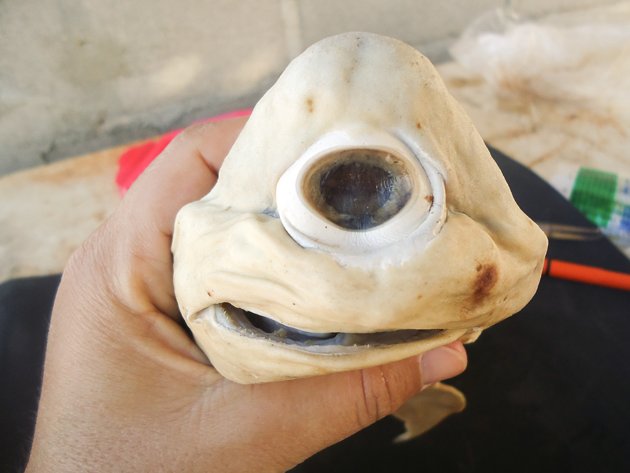
 A fetal shark cut from the belly of a pregnant shark caught in the Gulf of California. The shark, which would likely not have survived outside the womb, had only one eye. CREDIT: Pisces Fleet Sportfishing.
Fisherman has discovered what appears to be a shark with a single eye in the centre of its face.
The albino ‘cyclops’ fetus was cut from the belly of a pregnant bull shark caught in the Gulf of California this summer.
The one-eyed shark has achieved cult status since Pisces Fleet Sportfishing published pictures of it in July, giving rise to rumours of Photoshopping or other hoaxes.
close view of Cy. (Photo credit: Marcela Bejarano-Álvarez / National Geographic)
But shark researchers who have examined the creature say it is genuine, although it is unlikely it would have survived after birth, MSNBC reported.

Shark expert Felipe Galvan Magana, of Mexico’s Centro Interdisciplinario de Ciencias del Mar, said: ‘This is extremely rare. As far as I know, less than 50 examples of an abnormality like this have been recorded.’
 (Photo credit: Marcela Bejarano-Álvarez / National Geographic)
The shark’s condition is known as cyclopia, and is a rare congenital disorder characterised by the failure of the front portion of the brain to properly divide the orbits of the eye into two cavities.
Cyclopia occurs within the spectrum of brain and face defects known as holoprosencephaly, which in severe cases can result in miscarriage or stillbirth.
In 2005 a kitten born with only one eye and no nose caused a similar online stir.
The feline, one of two in a litter, became known as Cy (short for Cyclops) and died within a day.
(MSNBC)
»»  read more

10 Oct 2011

Lair of Ancient 'Kraken' Sea Monster Possibly Discovered

A giant sea monster, the likes of the mythological kraken, may have taken out ichthyosaurs the size of school buses, arranging their vertebrae in curious linear patterns with nearly geometric patterns (shown here). The arranged vertebrae resemble the pattern of suckers on a cephalopod's tentacle.  CREDIT: Mark McMenamin
A giant sea monster, the likes of the mythological kraken, may have swum Earth's ancient oceans, snagging what was thought to be the sea's top predators — school bus-size ichthyosaurs with fearsome teeth.
The kraken, which would've been nearly 100 feet (30 meters) long, or twice the size of the colossal squid, Mesonychoteuthis, likely drowned or broke the necks of the ichthyosaurs before dragging the corpses to its lair, akin to an octopus's midden, according to study researcher Mark McMenamin, a paleontologist at Mount Holyoke College in Massachusetts. [Rumor or Reality: The Creatures of Cryptozoology]
There is no direct evidence for the beast, though McMenamin suggests that's because it was soft-bodied and didn't stand the test of time; even so, to make a firm case for its existence one would want to find more direct evidence.
McMenamin is scheduled to present his work Monday (Oct. 10) at the annual meeting of the Geological Society of America in Minneapolis.
Cause of death
Evidence for the kraken and its gruesome attacks comes from markings on the bones of the remains of nine 45-foot (14 meter) ichthyosaurs of the species Shonisaurus popularis, which lived during the Triassic, a period that lasted from 248 million to 206 million years ago. The beasts were the Triassic version of today's predatory giant squid-eating sperm whales.
Mark McMenamin, a paleontologist at Mount Holyoke College in Massachusetts was interested in solving a long-standing puzzle over the cause of death of the S. popularis individuals at the Berlin-Ichthyosaur State Park in Nevada. An expert on the site, Charles Lewis Camp of U.C. Berkeley, suggested in the 1950s that the ichthyosaurs succumbed to an accidental stranding or a toxic plankton bloom. However, nobody has been able to prove the beasts died in shallow water, and recent work on the rocks around the fossils suggests they died in a deepwater environment, McMenamin said. [See image of kraken's lair]
"I was aware that anytime there is controversy about depth, there is probably something interesting going on," McMenamin said. And when he and his daughter arrived at the park, they were struck by the remains' strangeness, particularly "a very odd configuration of bones."
The etching on the bones suggested the shonisaurs were not all killed and buried at the same time, he said. It also looked like the bones had been purposefully rearranged, likely carried to the "kraken's lair" after they had been killed. A similar behavior has been seen in modern octopus.
The markings and rearrangement of the S. popularis bones suggests an octopus-like creature (like a kraken) either drowned the ichthyosaurs or broke their necks, according to McMenamin.
The arranged vertebrae also seemed to resemble the pattern of sucker disks on a cephalopod's tentacle, with each vertebra strongly resembling a sucker made by a member of the Coleoidea, which includes octopuses, squid, cuttlefish and their relatives. The researchers suggest this pattern reveals a self-portrait of the mysterious beast.
The perfect crime?
Next, McMenamin wondered if an octopus-like creature could realistically have taken out the huge swimming predatory reptiles. Evidence is in their favor, it seems. Video taken by staff at the Seattle Aquarium showed that a large octopus in one of their large tanks had been killing the sharks. [On the Brink: A Gallery of Wild Sharks]
"We think that this cephalopod in the Triassic was doing the same thing," McMenamin said. More supporting evidence: There were many more broken ribs seen in the shonisaur fossils than would seem accidental, as well as evidence of twisted necks.
"It was either drowning them or breaking their necks," McMenamin said.
So where did this kraken go? Since octopuses are mostly soft-bodied they don't fossilize well and scientists wouldn't expect to find their remains from so long ago. Only their beaks, or mouthparts, are hard and the chances of those being preserved nearby are very low, according to the researchers.
Though his case is circumstantial, and likely to draw skepticism from other scientists, McMenamin said: "We're ready for this. We have a very good case."
(LIFESCIENCE)
»»  read more

27 Sept 2011

Shipwreck of SS Gairsoppa reveals £150m silver haul

BBC NEWS/A shipwreck containing 200 tonnes of silver worth £150m has been discovered in the Atlantic - the largest haul of precious metal ever found at sea.
The SS Gairsoppa, a UK cargo ship sunk by a German U-boat in 1941, was found by US exploration firm Odyssey Marine.
The firm will retain 80% of the cargo's value under the terms of a contract with the Department for Transport.
Only one person from the 85-strong crew survived the torpedo attack as the ageing steamer tried to reach Ireland.
The vessel was on its way back to Britain from India when it ran low on fuel in stormy weather, and tried to divert to Galway harbour, but it was spotted and sunk by the German submarine.
'Robotic submarines'
Three members of the crew survived in a lifeboat and reached the Cornish coast two weeks later, but two died trying to get ashore.
The wreck of the 412ft ship was found this summer nearly 4,700m below the North Atlantic, 300 miles off the Irish coast, but it was only confirmed as SS Gairsoppa last week.
Odyssey Marine's senior project manager, Andrew Craig, said: "We've accomplished the first phase of this project - the location and identification of the target shipwreck.
"Now we're hard at work planning for the recovery phase.
"Given the orientation and condition of the shipwreck, we are extremely confident that our planned salvage operation will be well suited for the recovery of this silver cargo."
SS Gairsoppa settled upright on the seabed with its cargo holds open, which means remote-controlled robotic submarines should be able to retrieve the bullion.
The marine archaeology and exploration company said it was "highly unlikely" any human remains would be found, given the age and depth of the wreck.
Odyssey's chief marine archaeologist Neil Dobson said: "Even though records indicate that the lifeboats were launched before the ship sank, sadly most of her crew did not survive the long journey to shore.
"By finding this shipwreck and telling the story of its loss, we pay tribute to the brave merchant sailors who lost their lives."
The merchant ship belonged to the British India Steam Navigation Company, and was ordered into the merchant navy fleet at the outbreak of World War II.
A Department for Transport spokeswoman said: "The contract for the salvage of the SS Gairsoppa was awarded by competitive tender in accordance with government and departmental procedures.
"While we do not comment on the specifics of such commercial arrangements, Odyssey Marine Exploration were awarded the contract as they offered the best rate of return to HMG."
»»  read more

24 Sept 2011

Weird Science/Scientists claim that cars could run on old newspapers

Tulane associate professor David Mullin (right), postdoctoral fellow Harshad Velankar (center), and undergraduate student Hailee Rask have discovered a bacteria that converts the cellulose in newspapers to biofuel
Hopefully, your old newspapers don't just end up in the landfill. In the future, however, they might not even be used to make more paper - instead they may be the feedstock for a biofuel-producing strain of bacteria. Named "TU-103," the microorganism was recently discovered by a team of scientists at New Orleans' Tulane University. It converts cellulose - such as that found in newspapers - into butanol, which can be substituted for gasoline.
"Cellulose is found in all green plants, and is the most abundant organic material on earth, and converting it into butanol is the dream of many," said team member Harshad Velankar. "In the United States alone, at least 323 million tons [293 million tonnes] of cellulosic materials that could be used to produce butanol are thrown out each year."
The scientists first discovered TU-103 in animal feces, and have since cultivated it, and developed a patent-pending process that allows it to produce butanol from cellulose. In their lab, they have had success using newspapers as the cellulose source. While other bacteria have been found to produce butanol in the past, they have all required an oxygen-free environment, which increases production costs. TU-103, on the other hand, is able to survive and function in the presence of oxygen.
Although ethanol is also derived from cellulose, butanol is reportedly superior to that biofuel in several ways - it can be used as is in all unmodified automobile engines, it can be pumped through existing pipelines, it is less corrosive, and it contains more energy.
"This discovery could reduce the cost to produce bio-butanol," said David Mullin, whose lab in Tulane's
Department of Cell and Molecular Biology was the location of the research. "In addition to possible  savings on the price per gallon, as a fuel, bio-butanol produced from cellulose would dramatically reduce carbon dioxide and smog emissions in comparison to gasoline, and have a positive impact on landfill waste."
»»  read more

20 Sept 2011

18-Foot Anaconda Captured Alive

 A pet green anaconda, Eunectes murinus (Wikimedia Commons)
September has been a busy month for reports of giant reptiles. First a record breaking crocodile was captured in the Philippines.
Now, YahooNews reports that a massive 18-foot green anaconda (Eunectes murinus) was captured by a group exploring the Rewa River in Surinam. Where are Ice Cube, J-Lo, and Owen Wilson when you need them?
Niall McCann, a 29-year-old biologist from Wales, Robert Pickles, and their guides found the anaconda while trekking through a section of the Rewa River never before surveyed by scientists. They captured the snake in 2009, but didn't release photos until recently.
"The animals there had never seen people before so you could get incredibly close to them," McCann told YahooNews in an interview.
The team spotted the sizeable serpent on the river bank, but didn't tackle it at first.
"When you first see something of that size you just don't know how it will respond. We were very scared, we had heard innumerable horror stories of them taking people and killing them -- you know this is a seriously dangerous animal you are faced with," McCann said.
Three weeks later, the anaconda was still in the same spot. The explorers had gained experience catching caiman and smaller anacondas since their first encounter with the giant, and felt confident they were up to the 18-foot long challenge.

"We spent about 20 minutes preparing the landscape so we could encourage it to move inland, we didn't want it to go into the river as it could have escaped," McCann said.
"It would stretch out then coil, ready to strike, then stretch out and coil again. I said, 'right, next time it stretches I'm going to go for it.' It started to stretch out and I just leapt on top of it with both hands behind its head, my knee on its back and the other chaps piled on behind me," McCann continued.
"It was a struggle for the first 30 seconds or so as it tried to move its head from side to side. It tried to scratch at us then Ash, the head guide, came round the front and grabbed it by the jaws as I lifted it up -- wrapping its jaws with tape so it could no longer bite us," McCann said.

The snake wranglers made sure the anaconda couldn't escape with its mouth taped, which would have been a death sentence for an animal with no appendages. The team then measured it and released it.
At 18 feet, the anaconda may be one of the longest ever measured.
A 17 foot 1 inch (521 cm ) long female that weighed 215 lb (97.5 kilograms), was documented by Jesus Antonio Rivas in The Life History of the Green Anaconda (Eunectes murinus), with Emphasis on its Reproductive Biology. Other reports of anacondas reaching 24-27 feet have been reported by reliable sources.
Though rumors exist of anacondas reaching lengths of more than 30 feet, herpetologists doubt the accuracy of these claims.
SOURCE: DISCOVERY NEWS

»»  read more

17 Sept 2011

SC/How Pig Guts Became the Next Bright Hope for Regenerating Human Limbs

Corporal Isais Hernandez shows off his healing 
thigh muscles, credit photography : Scott Lewis
A remarkable substance extracted from pigs enables the body to regenerate lost muscle tissue, including fingertips and big chunks of muscle. And that may not be all it can do...

The strange sensation in his right thigh muscle began as a faint pulse. slowly, surely, it was becoming more pronounced. Some people would have thought it impossible. But Corporal Isaias Hernandez could feel his quadriceps getting stronger. The muscle was growing back.
When he first arrived in the trauma unit of San Antonio’s Brooke Army Medical Center in December 2004, Hernandez’s leg looked to him like something from KFC. “You know, like when you take a bite out of the drumstick down to the bone?” Hernandez recalls. The 19-year-old Marine, deployed in Iraq, had been trying to outfit his convoy truck with a makeshift entertainment system for a long road trip when the bomb exploded. The 12-inch TV he was clutching to his chest shielded his vital organs; his buddy carrying the DVDs wasn’t so lucky. 
Generally people never recovered from wounds like his. Flying debris had ripped off nearly 70 percent of Hernandez’s right thigh muscle, and he had lost half his leg strength. Remove enough of any muscle and you might as well lose the whole limb, the chances of regeneration are so remote. The body kicks into survival mode, pastes the wound over with scar tissue, and leaves you to limp along for life.
For Hernandez, it had been three years and there was no mistaking it: He had hit a plateau. Lately the talk of amputation had cropped up again. The pain was constant, and he was losing hope. Then his life took another radical turn. He saw a science documentary on the Discovery Channel (no relation to this magazine) that told the story of a war veteran in Cincinnati named Lee Spievack whose fingertip had been severed by the propeller of a model airplane. Spievack’s brother, a surgeon in Boston, had sent him a vial of magic powder—the narrator called it “pixie dust”—and told him to sprinkle it onto the wound. Lee was to cover his hand with a plastic bag and reapply the powder every other day until his supply ran out. After four months, Lee’s fingertip had regenerated itself, nail, bone, and all...

»»  read more
Related Posts .