Showing posts with label aquatic animals. Show all posts

19 Oct 2011

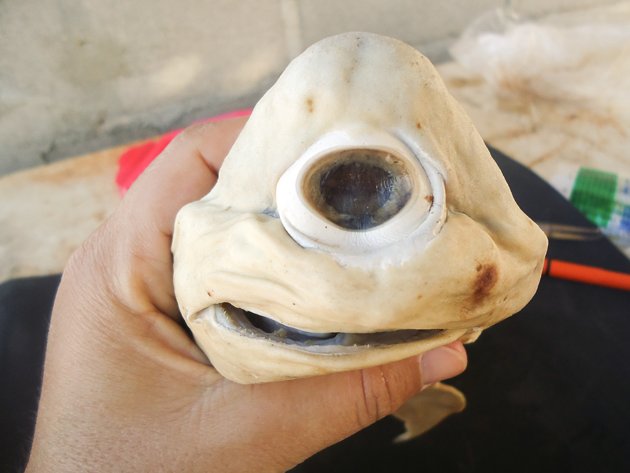
One-eyed albino shark-clops 'is not a fake', say experts

 A fetal shark cut from the belly of a pregnant shark caught in the Gulf of California. The shark, which would likely not have survived outside the womb, had only one eye. CREDIT: Pisces Fleet Sportfishing.
Fisherman has discovered what appears to be a shark with a single eye in the centre of its face.
The albino ‘cyclops’ fetus was cut from the belly of a pregnant bull shark caught in the Gulf of California this summer.
The one-eyed shark has achieved cult status since Pisces Fleet Sportfishing published pictures of it in July, giving rise to rumours of Photoshopping or other hoaxes.
close view of Cy. (Photo credit: Marcela Bejarano-Álvarez / National Geographic)
But shark researchers who have examined the creature say it is genuine, although it is unlikely it would have survived after birth, MSNBC reported.

Shark expert Felipe Galvan Magana, of Mexico’s Centro Interdisciplinario de Ciencias del Mar, said: ‘This is extremely rare. As far as I know, less than 50 examples of an abnormality like this have been recorded.’
 (Photo credit: Marcela Bejarano-Álvarez / National Geographic)
The shark’s condition is known as cyclopia, and is a rare congenital disorder characterised by the failure of the front portion of the brain to properly divide the orbits of the eye into two cavities.
Cyclopia occurs within the spectrum of brain and face defects known as holoprosencephaly, which in severe cases can result in miscarriage or stillbirth.
In 2005 a kitten born with only one eye and no nose caused a similar online stir.
The feline, one of two in a litter, became known as Cy (short for Cyclops) and died within a day.
(MSNBC)
»»  read more

17 Oct 2011

Special Photography/ Underwater Life(19 pics)


 Crab sitting on a net - Copyright Tanaka Juuyoh
Deep Blue Dolphin Love - Copyright LaPrimaDonna
I see you - Copyright Hamed Saber
Sea Anemone - Copyright Matt Clark
Star Attraction - Copyright LASZLO ILYES
Regal Queen - Copyright LASZLO ILYES
Caribbean Condylactis gigantae - Copyright LASZLO ILYES
Micro Cosmos - Copyright TANAKA Juuyoh
Cream Jellyfish - Copyright Chris Willis
Star - Copyright wrda

Curious Seal - Copyright Hugo
 Copyright LASZLO IYLES
Protecting and Hiding - Copyright Jenny


Juvenile Boxfish - Copyright NOAA Ocean Explorer

Bubble tip anemone - Copyright Ken Traub
Jellyfish - Copyright Schristia

Stingray drive-by - Copyright Jenny
 Sponge Brittle Stars - Copyright LASZLO ILYES
Flamingo Tongue Snail in Profile - Copyright LASZLO ILYES
»»  read more

16 Sept 2011

TOP 10 Glowing Sea Creatures

Queen Angelfish
Credit: Brandi Irwin, Liquid Film Photography
Photographer Brandi Irwin uses special lighting on night dives to capture otherworldly photos of sea creatures that fluoresce, including fish, coral and sea slugs.
Red and Green
Credit: Brandi Irwin, Liquid Film Photography
A light similar to a black light plus a special camera filter bring out colors not visible to the naked eye.

Glowing Coral
Credit: Brandi Irwin, Liquid Film Photography
Many of Irwin's photos are taken in the Caribbean, but she is planning a dive trip in Asian waters this fall.
Anemone Dance
Credit: Brandi Irwin, Liquid Film Photography
The fluorescing anemones are among the stars of a New York Aquarium show, opening August 5, of Irwin's work.
All coiled up
Credit: Brandi Irwin, Liquid Film Photography
An octopus peers out from the tangle of its legs. "I will come to the surface with whatever the ocean gives me," Irwin told LiveScience. "It's unpredictable down there."

Frilly Slug 

Credit: Brandi Irwin, Liquid Film Photography
A lettuce sea slug.

Bristle Worm
Credit: Brandi Irwin, Liquid Film Photography
A bristle worm glows green. Irwin's dives take place on moonlit nights.

Seahorse Meeting 

Credit: Brandi Irwin, Liquid Film Photography
Two seahorses photographed by Irwin.

Stingray 
Credit: Brandi Irwin, Liquid Film Photography
Sometimes black and white is more striking. Here, a stingray approaches a shipwreck.
Sunflowers of the Deep
 
Credit: Brandi Irwin, Liquid Film Photography
And sometimes the colors are riotous, as with these sunflower-like anemones.
»»  read more

14 Sept 2011

Weird Science/Sea Urchins See With Their Whole Body

Many animals have eyes that are incredibly complex -- others manage without. Researchers at the University of Gothenburg have shown that sea urchins see with their entire body despite having no eyes at all. The study has been published in the scientific journal Proceedings of the National Academy of Sciences (PNAS).
Most animals react to light and have developed a very sophisticated way of seeing complex images so that they can function in their surroundings. Good examples include insects' compound eyes and the human eye. Charles Darwin and other evolutionary biologists were bewildered by the eye's complexity and wondered how this kind of structure could have evolved through natural selection.
But some creatures, such as sea urchins, can react to light even though they do not have eyes. Previous studies of sea urchins have shown that they have a large number of genes linked to the development of the retina, which is the light-sensitive tissue in the human eye. This means that sea urchins have several genes that are coded for a widely occurring eye protein, opsin.
"It was this discovery that underpinned our research," says Sam Dupont from the University of Gothenburg's Department of Marine Ecology, one of the researchers behind the study and co-authors of the article. "We wanted to see where the opsin was located in sea urchins so that we could find the sensory light structures, or photoreceptors. We quite simply wanted to know where the sea urchin sees from."
The research group behind the study showed that the photoreceptors seem to be located on the tip and base of the tube feet that are found all over the sea urchin's body and are used to move.
"We argue that the entire adult sea urchin can act as a huge compound eye, and that the shadow that is cast by the animal's opaque skeleton over the light-sensitive cells can give it directional vision," says Dupont.
Story: University of Gothenburg
»»  read more

11 Sept 2011

SC/Dolphins Communicate by "Talking" Like Humans, Not Whistling

Dolphins produce sound using tissue vibrations comparable to how human vocal folds work
A team of researchers from the Department of Biological Sciences at Aarhus University has discovered that dolphins "talk" very similarly to the way humans do instead of whistling, like many previously thought.

For years, it was assumed that dolphins communicate through whistles because that's what it sounded like. While dolphins do have the ability to whistle for fun, like humans do, they do not primarily communicate that way.

"When we or animals are whistling, the tune is defined by the resonance frequency of some air cavity," said Peter Madsen, study leader from the Department of Biological Sciences at Aarhus University. "The problem is that when dolphins dive, their air cavities are compressed due to the increasing ambient pressure, which means they would produce a higher and higher pitch the deeper they dive if they actually whistle."

Madsen and his team have found that dolphins produce sound using tissue vibrations comparable to how human vocal folds work.

The team was able to come to these conclusions by digitizing and analyzing recordings of a 12-year-old male bottlenose dolphin from 1977. By doing this, they found that a dolphin breathes in a "heliox" mixture that consists of 80 percent helium and 20 percent oxygen. This combination would make humans sound like Donald Duck, according to the researchers, because it has a sound speed that is 1.74 times higher than normal air.

So if a person whistles after sucking in helium, the pitch will be 1.74 times higher than if that person had breathed in regular air.

"We found that the dolphin does not change pitch when it is producing sound in heliox, which means that its pitch is not defined by the size of its nasal air cavities, and hence that it is not whistling," said Madsen. "Rather, it makes sound by making connective tissue in the nose vibrate at the frequency it wishes to produce by adjusting the muscular tension and air flow over the tissue. That is the same way that we humans make sound with our vocal cords to speak."

The team believes that this finding applies to all toothed whales because they have the same nasal anatomy.

As far as what the dolphins are actually "saying" to one another, it's known that they share identity-related information in order to stay together when traveling. But according to acoustics engineer John Stuart and Speak Dolphin organization member Jack Kassewitz, dolphins have a complex system of social interactions that include sounds like chirps and clicks.

Stuart and Kassewitz developed an instrument called the CymaScope, which pictorially reveals structures within sounds. The CymaScope can be used to understand the dolphin language better in the future.

"There is strong evidence that dolphins are able to 'see' with sound, much like humans use ultrasound to see an unborn child in the mother's womb," said Kassewitz. "The CymaScope provides our first glimpse into what the dolphins might be 'seeing' with their sounds. I believe that people around the world would love the opportunity to speak with a dolphin. And I feel certain that dolphins would love the chance to speak with us -- if for no other reason than self-preservation."
(Source: agentgenius.com)
»»  read more

SC/Fish living in dark caves still feel the rhythm of life

Millions of years of evolution in the dark have led to this Somalian cavefish losing its eyes, scales, and pigmentation.
A blind, cave-dwelling fish in Somalia knows what time it is, but its "day" is twice as long as ours.
Most animals have an internal body clock, or circadian rhythm, that lasts around 24 hours and is modified by the light-dark cycle of a day.
But an international team, whose research is published in the open access journal PloS Biology, shows that certain blind cave fish have a circadian rhythm that lasts almost two days.
The cavefish, Phreatichthys andruzzii, has evolved for nearly two million years in the isolated darkness of caves beneath the Somalian desert.
Professor Nick Foulkes, of the Karlsruhe Institute of Technology in Germany, said that this particular species was chosen "because it was such an extreme example, having been isolated from a day-night cycle for so long".
In the course of its evolution it has lost its eyes, colouration and scales, having no need for them in the pitch-black of an underground cave system.
But it appears that the absence of day and night has caused a much more profound change in the fish's life rhythm.
Light sensitivity
The internal body clock of most mammals is slightly longer than 24 hours, although it is unique for each person and is modified by light.
“Start Quote
If we look again at them in a few million years, they may have no trace of a circadian rhythm”
Nick Foulkes Karlsruhe Institute of Technology
This is most obvious to us when we travel across time zones, as jet lag is caused by the delay in our circadian rhythm synchronising with the new daylight times.
On a smaller scale, the body clock can be measured by the switching on and off of certain "clock genes" at different times during the day. This happens automatically daily, but is synchronised with the day-night cycle through exposure to light.
Light is detected primarily by the eyes, but most cells in the body have some reaction to light levels. In non-mammalian animals, such as fish, these "peripheral" detectors play a more important role.
This means that, even though the cavefish have lost their eyes over the course of evolution, their bodies should still be able to react to changes in light.
When comparing the reactions of the circadian rhythm of the cavefish to those of a "normal" zebrafish, however, the blind fish showed none of the responses to external light changes that the zebrafish did.
After two million years in the dark, the cavefish have no need to react to the light, and their body clocks have permanently changed to reflect this.
Alternative triggers
But these blind fish do still have a body clock, which can be reset by triggers other than light.
Feeding the fish at regular times showed that both the zebrafish and the cavefish responded by resetting their circadian rhythms.
Furthermore, when the cavefish were left to reset their clock according to their natural rhythm, the researchers found that their "day" is 47 hours long.
Professor Foulkes said that this was "possibly linked with food availability, or we could have caught them in the process of losing their clocks. If we look again at them in a few million years, they may have no trace of a circadian rhythm".
The team plans to investigate whether this gradual loss of body clock is a common feature among all species of fish living in perpetual darkness.

 source: BBC News
»»  read more

29 Aug 2011

Top 10 Scariest Sea Creatures

Dangers in the Deep
On land during the day, we humans rule. Or at least we're considered top predators, and with our feet on the ground, we're in our element.
In the sea, sans a boat, forget about it. We're too slow, too encumbered with gear, and often too stupid to be much more than prey. What's to worry about down there? Plenty!
Yes, this list is subjective, but it's based on research aimed at finding the creatures of the deep that conjure the most compelling combination of frightening personas, actual aggression and/or real pain or death to humans. More often than not, pain and death from sea creatures is avoidable, especially in the case of two on this list that inflict most of their damage in home aquariums and restaurants.
Before we continue, a nod to venerable contenders that aren't on the list: killer whales (there are few confirmed attacks, accept by those in captivity), octopuses (yes, they've been known to attack), sea cucumbers (who'da thunk?) and piranhas (which actually live only in freshwater, and whose deadly attacks on people are pure myth).
10. Box Jellyfish
Credit: Anders Garm
These gelatinous creatures are flat-out deadly. 
While no official tallies exist, anecdotal evidence suggest dozens of people and perhaps more than 100 or more die each year from the many species of box jellyfish that exist in all oceans.
Some 20 to 40 people die from stings by box jellyfish annually in the Philippines alone, according to the U.S. National Science Foundation. "But because death certificates are not required in many countries within the range of box jellyfish, worldwide fatalities from box jellyfish may be seriously underestimated," the NSF states.
One Australian box jellyfish can have dozens of tentacles, each up to 15 feet long, with enough toxin to kill 60 people. The sting of a Chironex fleckeri box jellyfish can kill a person in less than three minutes. Species of box jelly fish in Hawaii, Florida and other U.S. locations are known to induce heart failure.
Honorable mention goes to the Portuguese man-of-war, a jellyfish with a sting said to be as painful as a lightning strike — though it's not clear how many people are actually able to make that comparison.
9. Tiger sharks
Credit: Klaus Jost
Yeah, yeah, the great white shark gets all the attention. But reality is tiger sharks kill more people. And few things (other than snakes) automatically terrify people more than sharks.
Tiger sharks will eat anything: fish, seals, birds, squid, small sharks, dolphins, license plates and pieces of old tires, according to NOAA. They can grow more than 18 feet long and weigh a ton. Take that, Jaws!
Tiger sharks are found in many tropical and temperate waters, and they are especially common around islands in the central Pacific. For the record: Great whites do attack more people each year, on average.
Oh, and a little detail that explains why sharks aren't No. 1 on this list: The number of people attacked by sharks worldwide each year — a few dozen — is roughly equal to the number killedby lightning just in the United States. Only four people around the world died from shark attacks last year.
8. stonefish
Photo Credit: William Leo Smith, AMNH
This one nearly tops the list for two reasons: It's the most venomous fish in the world, and it's a master of disguise, hiding in plain sight on the seafloor, looking like any other rock.
The stonefish doesn't attack, but you don't want to step on it. Its spines are used as defense against sharks and other predators. The venom can cause temporary paralysis and death if not treated.
7. pufferfish
Credit: © Briankieft | Dreamstime.com
You don't even have to be near water for this creature to kill you. The pufferfish, also known as a blowfish, packs tetrodotoxin — stronger than cyanide. Specially trained Japanese chefs prepare safe parts of the fish as a delicacy, but every now and then a diner dies.
The puffer, named for its ability to suck in water and swell to twice normal size, could end up saving people: a drug made from the puffer's toxin has been tested for treatment of withdrawal symptoms from drugs like heroin.
6. sea snakes 
Credit: Leslie Babonis
The innate human fear of snakes propels these slithering swimmers to the list. However, the truth is that while sea snakes out-venom their terrestrial counterparts, they're highly reclusive and so not much of a threat.
5. Lionfish
Credit: Oregon State University
Popular in home aquariums, these docile fish sport a striking fan of venomous spines.
Although not fatal to humans, the spines deliver a painful sting that can cause headaches, vomiting, and respiratory distress, according to NOAA. The worst of the pain typically lasts only for about an hour, but some people report pain and tingling sensations for weeks.
Lionfish are not aggressive. So the fact is home aquarium owners are more likely to be stung by lionfish than divers or fishermen.
4. Saltwater crocs
Credit: Oscar Baldomero.
Saltwater crocs have earned a reputation as one of the wild kingdom’s most ferocious predators.
They can grow more than 20 feet long and weigh 3,000 pounds, and they have been known to hunt a wide range of prey, including monkeys, kangaroos, buffalo and even sharks.
Relying on purely brute strength, they are capable of dragging down water buffaloes and have occasionally victimized humans. Using an attack method known as the “death roll,” crocodiles kill their prey by latching on with their jaws and then taking down the dinner with a powerful, twisting roll. The technique is also employed to break apart large animals
 3. stingray
credit: Mark Aplet, Dreamstime.com
Just the name practically qualifies these creatures for this list. And the death of "Crocodile Hunter" Steve Irwin by stingray in 2006 certainly solidified the reputation of these shark cousins as dangerous beasts.
The tail of of a stingray is capped with a roughly 8-inch spear made of the same stuff that makes up shark scales, known as dermal denticles. The spear, which stiffens when the stingray feels threatened, is serrated like a steak knife and packs a venom that can be deadly to predators.
"The venom itself is a largely protein-based toxin that causes great pain in mammals and may also alter heart rate and respiration," according to the Mote Marine Laboratory.
Stingrays don't typically attack humans, however.
2. sea lions
Really? Sea lions? Yes, because they're very territorial.
They’re considered cute, trainable and are major attractions at zoos, but have been known to bite people.
In California, a spate of vicious sea lion attacks reported at Manhattan beach, Newport beach and San Francisco back in 2006 led to growing concern among caretakers and scientists. Some researchers suspect the sea lions may have eaten fish contaminated by toxic algae, which may explain the uncharacteristic behavior.
The city of San Diego warns on its web site “Like all wild animals, seals and sea lions are unpredictable and can become aggressive quickly. They have sharp teeth and may bite, particularly if cornered or harassed.”
1. morays

Credit: John E. Randall, Bishop Museum.
Snakelike body, protruding snout and wide jaws. These primitive creatures just look like death. They're fish, by the way, and they can be up to 8 feet long.
A bite from their razor-sharp teeth and powerful, locking jaws will produce ragged wounds that are prone to infection from the bacteria inside the eels’ mouths, according to NOAA. The good news: If morays bite out of fear or by accident (especially when foraging for food), they will usually release their grip and let you go.
They tend to hide in crevices and holes during the day, then hunt at night. They'll eat any fish or other creature they can catch.
Some expert advice, from NOAA, on how to avoid being bitten by one: Keep your hands out of submerged, rocky holes and crevices. Oh, and avoid this common diver gaffe that leads to many moray eel bites: Don't feed them!
»»  read more

22 Aug 2011

Top 10 Weirdest Sea Creatures

No. 10 - Blobfish
blobfish
In case you ever wondered where the creator of Ziggy came up with the artistic concept, wonder no more. This fish (if "fish" we can really call it) is the weirdest looking sea creature we've ever seen. What's worse is that this animal is just as lazy as it looks and sounds...it barely expends any energy even eating, making sure it gobbles up whatever just happens to be floating by at the moment. So maybe a little less Ziggy ... a little more Al Bundy. Either way, it makes us seriously think about our carb intake.
No. 9 - Axolotl
Axolotl
Axolotls are like the cute anime pet you never had but always wanted, because you saw it on a deck of Pokémon cards. Tack onto that the ability to completely regenerate any dangling limb, and you've got yourself a real live Tamigachi! Another cool thing about axolotls is that they stay in their larval state even into adulthood, when they start becoming sexually mature—talk about babies having babies! Maury Povitch would have a field day with these weird sea creatures. Which of course, only makes them weirder.
No. 8 - Frilled Shark
frilled shark
Its oxymoronic-sounding name alone conjures up visions of a shark from a Disney movie—a fluffy, fun little animal that wags its fin like Pluto wags its tail. Well, perhaps that assessment isn't too far off. The frilled shark is not your typical shark, judging by looks alone. It closely resembles an eel—so much so that it's mistaken for an eel quite often, and the only real distinguishing features are its signature six gill slits (that's like a "Hell's Angel" tattoo for sea creatures).
One more weird thing about this sea creature: they came back from the dead. Well, sorta … these animals were long thought to be extinct (they had the fossils to prove it!). It wasn't until 2007 that someone witnessed a real live frilled shark wash up on the shore.
No. 7 - Anglerfish
angler fish
We'll say it, and we'll say it without fear: anglerfishes are ugly. There, we said it. They are disgusting bottom-dwellers, and if that isn't the lowest of the low, they also have a spine that doubles as bait for prey. They have big pointy teeth, and we're pretty sure you don't want to know what their mating habits are. All in all, "weird" only scratches the already scaly surface.
No. 6 - Loch Ness Monster
loch ness monster
While the Scottish Highlands have a history of having things appear out of the mist (is Brigadoon humor still in, or is 60+ years too much time?), it is the The Loch Ness Monster, or "Nessie" as we've come to know her, that has become the most popular Scottish Highlands' mist-dweller. The story goes that in August of 1933, the Courier published an article stating that a man had witnessed what appeared to be a dragon ... or at least, the closest thing he had ever seen to a dragon. Years passed, and evidence proving Nessie's existence (including photographs, video and even sonar) mounted. Because of this evidence, The Loch Ness Monster has been neither confirmed nor denied—though the scientists in the room may beg to differ.
No. 5 - Dana Octopus Squid
dana octopus squid
This weird sea creature mesmerizes its prey by flashing it—but not in the what's-under-that-trench-coat kind of way. In an actual, literal light-gets-in-your-eyes kind of way. By emitting flashes of light used to blind their prey, the Dana Octopus Squid successfully disorients, then captures them. Which begs the question: whatever happened to stimulating conversation?
No. 4 - Leafy Sea Dragon
sea dragon
The Leafy Sea Dragon is one of the few sea creatures with its own built-in camouflage. The tiny fins that are used to propel our leafy friend forward are impossible to see, giving the illusion that you are merely watching some seaweed lazily float by (like an underwater plastic bag à la American Beauty). So the next time you see a chunk of seaweed ... notice the beauty of it, yes. But also notice that you may just be witnessing one of the weirdest sea creatures in the world.
No. 3 - Longhorn Cowfish
cow fish
Although the Longhorn Cowfish tends to look like a hovercraft when it's moving along, it's not quite as fun as the Bumper Car-esque exterior it tends to exude. In fact, what it does exude is a poisonous toxin from the mucous secretions of their skin, rendering their flesh a deadly delicacy (should you be so inclined to eat one, since it has "cow" in the name and fast food these days will take anything they can get). The good news is, they tend to make a very distinct grunting noise when they've been captured—so just be sure to listen carefully to your next double cheeseburger.
No. 2 - Viperfish
viper fish
Even without the visual aid, we're pretty sure we can explain what a viperfish looks like: imagine a baseball bat with the head of Predator. Then add some scales and the gnarliest teeth you've ever seen (they are so large, they don't even fit in its mouth—they curve backward up toward its eyes). Finally, it has a radio antenna on top of its Predator head—you know, so it doesn't miss the game. Well, that's not entirely true: the "radio antenna" actually works as a fishing lure for its prey. By flashing the light at the tip on and off, it attracts passers-by that may (or may not, in most cases) want to be eaten. Sort of like a taxi cab! Although you're probably safer in a viper ... fish, that is.
No. 1 - Vampire Squid
vampire squid
Helping it stay true to its name, the Vampire Squid comes complete with its own cape, made from arms connected by black webbing. The webbing help propel it through the water and almost fly like—you guessed it—a bat. But by far, the coolest/weirdest thing about this sea creature is its ability to hypnotize its prey using what's knowns as "photophores" on its arms. So basically it's a living, breathing dance club.


»»  read more
Related Posts .