Showing posts with label education. Show all posts

20 Nov 2011

Space siblings at least two years apart to make them smarter

According to a new study by University of Notre Dame economist Kasey Buckles and graduate student Elizabeth Munnich, siblings spaced more than two years apart have higher reading and math scores than children born closer together. The positive academic effects of greater spacing between children were seen in older siblings, but not in younger ones, according to Buckles.

The study will be published in an upcoming issue of the Journal of Human Resources.

Using the 1979 National Longitudinal Survey of Youth (NLSY79), researchers sampled a nationally representative panel survey of 12,686 young people ages 14 to 22 in 1979, and their children. The study was designed to identify the causal effect of spacing on academic achievement.

“Our results indicate that longer gaps improve test scores for older children, and have no effect on the scores of younger children,” Buckles says. “This appears to be due in part to the fact that older children get more of their parents’ time when the younger sibling is not born until a few years later.”

Earlier research in other fields has focused mostly on the effects of small gaps (less than two years) between siblings on early outcomes such as birth weight and infant mortality. Buckles’ study investigates the effects of birth spacing on later-life academic performance as measured by the Peabody Individual Achievement Tests for math and reading.

“Parents often wonder whether there is an ideal spacing between children. Our results suggest that for at least one important outcome—academic achievement—greater spacing can improve outcomes for the older sibling.”
»»  read more

5 Nov 2011

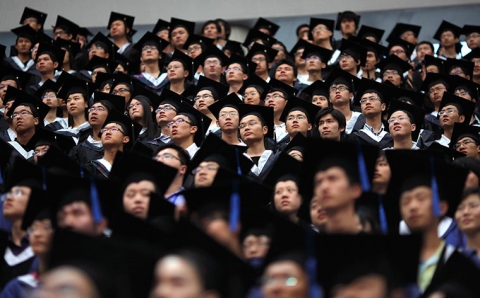
How Shanghai’s students stunned the world

They beat every other country on international exams, but Chinese educators say their success is no fluke


SHANGHAI, China — Students in this booming Chinese city shocked the world last year when they beat every other country on international exams, but Chinese educators say their success is no fluke.
“If you are a hard-working, diligent student you will succeed," said Qiu Ying Li, who has been teaching English for 20 years. "This is the secret for all Chinese students.”
At Shanghai’s Yucai High School, students put in 12-hour days – nine hours before dinner plus three after they eat. Homework is assigned every evening, even for weekends, as an essential part of students’ learning activities. And kids study during summer and winter breaks to get ready for high-stakes college entrance tests.
With all of this hard work comes stress. To help students cope, time is set aside for workouts and even eye massages.
“It’s a test-oriented education system, which means students are taught from a very early age how to beat tests,” said Jiang Xueqin, deputy principal of Peking University High School.
Students are even tested in English, which they start learning at six years old. The approach seems to be paying off.
In the last worldwide evaluation of students’ performance, administered by the Organisation for Economic Cooperation and Development (OECD), Shanghai pupils’ scores topped the charts across the board in math, science and reading. Shanghai was the only site in China where the tests were administered.
In the same test, American students ranked 25th in math, 17th in science and 14th in reading.
China has a long tradition of valuing education, seen as the major path to climb the country’s social ladder. But just a couple of decades ago, Shanghai schools were struggling, so officials launched a reform effort hinged on making the curriculum much more rigorous, and they invested heavily to do so.
“Culture may well be an asset,” Andreas Schleicher, OECD education expert, said, “but you also need to enable your asset.”
Today, this international business hub of 23 million people pours vast resources into its schools, and its teachers are among the highest paid in the nation.
When asked if student discipline is ever an issue, Luo Jian Jun, an English teacher, shot back a confused look.
“You just give your lesson and students just listen to you, maybe write down, sometimes they ask questions. No discipline problem,” Luo said.
In English class, a young man nicknamed Bill said his life revolves around school. “It’s all about studying,” he said, laughing. “I got to make money, I got to make a living.”
Another student said he pushes himself to work hard in school so he can achieve his goal of working in an organization that protects ocean creatures.
Schleicher, of the OECD, believes the most impressive result of Shanghai’s performance is not just its high average score, but the low variability of test scores between schools, even those in poorer districts.
A determined effort to convert weaker schools into stronger schools produced these results, as high-performing teachers and school managers were transferred to low-performing schools, either temporarily or permanently, Schleicher said.  School officials also share lesson plans, curricula, teaching methods and effective practices.
Schleicher said U.S. schools could benefit by making high-performing teachers more mobile, so disadvantaged schools could also benefit from their expertise.
Shanghai is proud of how it performed on the international tests, but experts say there is a downside to the emphasis on test taking.
Jiang believes test taking is damaging to students’ creativity, critical thinking skills and, in general, China’s ability to compete in the world.
“It can make students very narrow minded,” he said, adding that, in the 21st century, China needs the creative types its education system isn’t producing.
Jiang also points out that Shanghai, the country’s wealthiest city is the exception in China. Only 24 percent of rural Chinese kids go to college versus 80 percent in Shanghai and 64 percent in the United States. Many children walk miles every day to rundown schools – if they’re among the lucky ones who have access to a school.
“Shanghai is definitely an outlier in China,” he said.
But one quality that all Chinese students share, Jiang said, is their love of learning – a positive attitude he thinks American students should emulate.
“Chinese students love learning. They go to class and they have a real attitude that ‘education can change my life.’”
By NBC, msnbc
»»  read more
Related Posts .