Showing posts with label nature photos. Show all posts

13 Nov 2011

Special Photography/ Life in Color: Blue by National Geographic

Galápagos Lagoon
Photograph by Bobby Haas
As startling as a bright-blue eye, a central lagoon peers out from Rocas Baimbridgen in Ecuador's Galápagos Islands. The stark, rocky island teems with life at times—the brackish lagoon waters are favored by flamingos.
Azurite
Photograph by David Boyer
Some of nature's intricate patterns are on display in this magnified view of the mineral azurite. The bright blue mineral was once used to make paints and may still be found in jewelry.
Barracuda School
Photograph by Tim Laman
A thick, swirling school of blackfin barracuda plies the blue waters off Sipadan Island, Malaysia. The fish are formidable predators, but they sometimes gather in groups for protection against sharks higher up on the food chain.
Snowy Grand Canyon
Photograph by Michael Nichols
Though it's better known for shades of red, the Grand Canyon is shrouded in blue as night descends on its foggy, snow-covered walls. The canyon's north rim is typically closed to vehicles in winter.
Blue-Footed Booby
Photograph by Tim Laman
These distinctive webbed feet belong to a blue-footed booby of the Galápagos Islands. The bluer, the better: Courting males show off with a high-stepping strut—and those with brighter feet are more attractive to potential mates.
Frosted Ferns
Photograph by Annie Griffiths Belt
Frost covers the brilliant blue leaves of lush ferns in New Zealand's Fiordland National Park. The park is an isolated wilderness that's home to more than 700 plants found nowhere else in the world.
Garibaldi Glacier
Photograph by Richard Nowitz
The massive bulk of Garibaldi Glacier slowly spills into Garibaldi Fjord in Tierra del Fuego—the archipelago at the southern tip of South America. The aquatic endpoint of such a glacier is known as a terminus.
Underwater Sea Ice
Photograph by Paul Nicklen
Ice, seen from below, covers the surface of the Arctic's Beaufort Sea. The sea is found north of Alaska and Canada.
Arctic Igloo
Photograph by Norbert Rosing
A homey-looking igloo lights up the stark landscape on a cold night in the Canadian Arctic. These temporary shelters were commonly used by indigenous peoples in the frigid North American Arctic
Iranian Mosque
Photograph by Alexandra Avakian
Intricate blue tiles adorn the walls of a large Iranian mosque and mirror a clear sky that beckons the faithful to the sunny courtyard. The mosque's many arches are a prominent feature of Islamic architecture.
Peacock Courtship
Photograph by Anne Keiser
Unveiling the regalia that has captivated humans (and hens) for thousands of years, an Indian peacock displays his colorful train at an Australian reserve. Males may use their feathers to attract harems of several hens.
Iceberg Penguins
Photograph by Ralph Lee Hopkins
A group of chinstrap penguins lines the edge of an iceberg adrift in Antarctic waters. Chinstraps are among the most abundant penguins, and some colonies live on floating icebergs.
Glacier Pool
Photograph by Rich Reid
A blue pool on Root Glacier in Alaska's Wrangell-St. Elias National Park reflects the bulk of towering Donoho Peak. The massive ice sheet is a popular excursion in the park.
Blue Waterslide
Photograph by James Stanfield
Holidaymakers take the plunge and enjoy a twisting, turning trip down an Israeli waterslide. The attraction cools tourists who visit the shores of the Sea of Galilee.
Whale Shark
Photograph by Brian Skerry
The sweeping color of sea and sky, blue is a common thread in nature, seen in the cerulean of a whale shark (pictured here), the indigo of a stormy night, and the cobalt of a peacock's feathers. Over the centuries, the hue has come to represent calm, cold, mysticism, and sadness.
Yellowstone Wolf
Photograph by Joel Sartore
Bathed in blue light, a gray wolf peers through the misty landscape of Yellowstone National Park in the U.S. West. The animals were successfully reintroduced to the park in the mid-1990s after an absence of nearly seven decades.
Polar Bear in Svalbard
Photograph by Ralph Lee Hopkins
A polar bear leaps off of sea ice near Devon Island in the Canadian Arctic. Strong swimmers, polar bears have slightly webbed paws to aid in paddling.
»»  read more

11 Nov 2011

Mars volcano in Pictures(6 Photos)

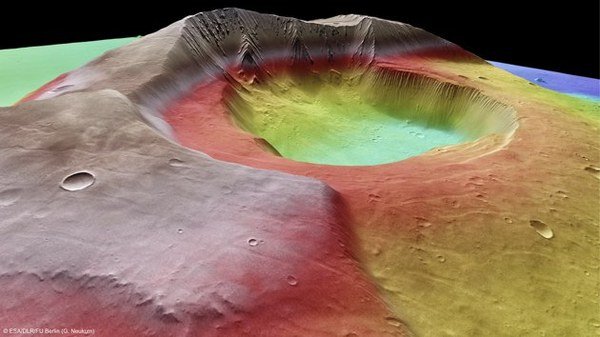
The European Space Agency recently released stunning images of one of the planet's most striking features: the Tharsis Tholus volcano.
The area surrounding the mountainous landmark is relatively bare, causing the huge Martian structure to stand out. When active, Tharsis Tholus was likely much larger than it is today. Image Credit: ESA/DLR/FU Berlin (G. Neukum). Photo courtesy of Tecca
The planet Mars is a bit of an obsession for the human race. We've romanticized the red planet in everything from movies to video games, and we can't seem to get enough of the barren, desert-like planet. The European Space Agency isn't immune to Mars lust, and the organization recently released some stunning images of one of the planet's most striking features: the Tharsis Tholus volcano. Presented with false color to highlight its geographical features, the once-lively mountain is still a sight to behold. Join us as we take a tour of a true Martian landmark. Image Credit: ESA/DLR/FU Berlin (G. Neukum). Photo courtesy of Tecca
The Tharsis Tholis volcano stands 5 miles tall on the rocky Martian landscape, dwarfing the tallest volcanoes on Earth. Ojos del Salado on the Argentina-Chile border comes closest, measuring 4.2 miles tall. Image Credit: ESA/DLR/FU Berlin (G. Neukum). Photo courtesy of Tecca
 The expansive crater located in the center of the volcano resulted from the loss of supportive magma that the mountain spewed billions of years ago. With the interior of the volcano lost, its roof caved in, forming the giant hole we see today. Image Credit: ESA/DLR/FU Berlin (G. Neukum). Photo courtesy of Tecca
Over the course of billions of years, Tharsis Tholus has become dotted with the scars of small to medium-sized impacts from space debris. The mountain is in an advanced state of erosion, making it particularly interesting to scientists looking to study the history of the red planet. Image Credit: ESA/DLR/FU Berlin (G. Neukum). Photo courtesy of Tecca
 Tharsis Tholus' large size is aided by the relatively low gravity of Mars. With less than half of the gravitational force of Earth, it is easier for huge geographical features to exist on the Martian landscape. Image Credit: ESA/DLR/FU Berlin (G. Neukum). Photo courtesy of Tecca
»»  read more

25 Oct 2011

Special Photography/Songbird Photos

Blue Jays
Photograph by Jerry Smith
This was done on a cloudy, dreary kind of day using flash.

Scarlet Tanager
Photograph by Mark Lewer
A truly “wow” bird. A real treasure to have in your area.
Brown Shrike
Photograph by Ralf Nabong
This photo of the brown shrike (Lanius cristatus) shows a proud look after a successful landing on a bamboo pole. This was taken inside a pond at the University of the Philippines.
Pyrrhuloxia
Photograph by Tom Dietrich
Pyrrhuloxia in cactus
Cerulean Warbler
Photograph by Wil Hershberger
The heart of the breeding population of cerulean warblers occurs where mountaintop removal threatens the very existence of their breeding habitat and thus the future of this beautiful warbler. Neotropical migratory birds from warblers to sparrows are declining at alarming rates—rates that are not sustainable. Unless our culture sees these creatures as necessary, they will vanish into history, remembered only by photographs and paintings.
Japanese White-Eye
Photograph by Michael Lynch
Many parts of the world are celebrating the opening of cherry blossoms as the first sign of spring. Okinawa is the first place in all of Japan to see them bloom. This photo of a bird (Japanese white-eye) in the cherry blossoms was taken January 19, 2009, using a handheld Pentax K10D with a Sigma 50-500mm lens.
Lark
Photograph by Kishor Gumaste
The larks are very interesting and hardworking birds. I admire them for their camouflage and courage with which they defend their nests and raise their young against all odds. Even though they are not colorful, the patterns are beautiful. Overall a very beautiful bird. 
Sparrows
Photograph by Andrew Dillon
A pack of sparrows pick anxiously at a cupcake wrapper in New York City. Picture taken in a chess-playing park across the street from Magnolia Bakery (where the cupcake was purchased).

Thrasher
Photograph by Harry Taylor
Thrasher eyeballing organ pipe cactus fruit
American Goldfinch
Photograph by Phillip Woodward
This golden finch is one of a flock feeding in this patch. 
White-Cheeked Bulbuls
Photograph by Behzad Farahanchi
Spring 2008, Tehran. White-cheeked bulbul feeds her/his juveniles.


American Robin
Photograph by Mark Lewer
Early robin and late snow
Tree Swallow
Photograph by Kathrine Lloyd
I was walking the loop trail at my favorite birding location in Seattle and thought I'd stop near the nest boxes to see if any of the tree swallows were actually using them. I walked past several that appeared vacant and just for fun, I said, "Anybody home?” This tree swallow appeared and looked at me as if he was saying, "Who wants to know?"

Purple Sunbird
Photograph by Md Abdul Hakim
This is a purple sunbird, and I took this picture from Chittagong in Bangladesh. For this picture, I took about 30 minutes. Camera was D80, and lens was 400mm, 2.8. I love this picture; here I can feel the freedom of flight.

Sparrow Singing
Photograph by Wes Allen
Upon reaching the ruins, I quickly deviated from the tour group and set out on my own. I followed this bird around for about a half hour before getting close enough to get this photo. Immediately after I took the shot, a tour group scared him away.
Honeyeater
Photograph by Casey Argall
______________________________________________
(CREDIT: NATIONAL GEOGRAPHIC)
»»  read more

22 Oct 2011

Special Photgraphy/Into the Amazon Rainforest

The “lungs of our planet” have been attributed to the Amazon rainforest, also known as Amazonia. This Amazon jungle, or the Amazon basin in South America, covers over 1.7 billion acres acres (7,000,000 square kilometers); the actual tropical rainforest is spread over 1.4 billion acres and 9 countries: Brazil, Peru, Colombia, Venezuela, Ecuador, Bolivia, Guyana, Suriname and French Guiana. 60% of the Amazon jungle is contained within Brazil. The Amazon represents over half the remaining rainforests worldwide and contains the largest and most species-rich tropical forest system on our planet. Amazonia grew around the Amazon River which is the longest river, the largest river, and the basin has the largest area in the world. The Amazon River has total flow greater than the top ten world’s rivers combined. The biodiversity of this wet tropical forest could boggle the brain; one in ten animal species lives here and it is the largest collection of living plants on the globe . . . and much of the Amazon is still unexplored. It definitely should be protected for the tropical jungle paradise may hold the keys, yet to be discovered, to cure countless diseases.
A Yagua (Yahua) tribeman demonstrating the use of blowgun (blow dart), at one of the Amazonian ‘islands’. (Photo by JialiangGao www.peace-on-earth.org)
The photographer wrote of the ‘Wild Boy’, “His eyes reflects the nostalgia of an almost extinct World. Wearing an Amazon Toucan, traditionally used only for the sacred dances and very special moments, this boy is learning from the Shamans the traditional dances of the Kotococha culture, a knowledge which is only transmitted from the shaman to the few chosen by word of mouth. Origin: Ecuadorian Amazon rainforest, Kotococha tribe.” (Photo by Gustavo Morejón)
Monkeys hanging out in the tropical jungle. (Photo  by Worldwide Happy Media)
You might see a Tupi ‘red bird,’ also known as the scarlet ibis, one of the most beautiful Brazilian birds, because of the color of their plumage. (Photo by J.Gil Photography)
The biodiversity in these wet tropical forests is mind-blowing. It is home to the largest collection of living plant and animal species in the world. One in ten known species on this planet lives in the Amazon Rainforest. Amazonia is home to around 2.5 million insect species, tens of thousands of plants, and more than 2,000 birds and mammals. So far, at least 40,000 plant species, 2,200 fishes, 1,294 birds, 427 mammals, 428 amphibians, and 378 reptiles have been scientifically classified within this region. One in five of all bird and fish species live here. The Scarlet Macaws above are indigenous to the American tropics. The photographer wrote, “Red-and-Green Macaws DO grow on trees in the Amazon.” (Photo by Billtacular)
Or you might see an Amazonian ‘Godzilla.’ Photo  by Laurent
 In Amazonia, you might even stumble upon an Emerald Boa. Eek! (Photo by Free Pet Wallpapers)
Looking down at the ‘lungs of the planet.’ (Photo  by Wallpapers Diq)
The photographer explained, “On the Tambopata River in the Peruivan Amazon Rainforest, a group of kids play football on a tiny sand island in the middle of the river.” (Photo by Mike Cooper)
Toucan, the earl of Amazonia.(Photo Tambako the Jaguar)
Amazonian Sunset.( Photo by New7Wonders of Nature)
Native village of Chipitiere, in the Cultural Zone of Manu National Park, Peru. (Photo by Martin St-Amant)
Amazon Poison Dartfrog, also known as the Reticulated Poison Frog, can be found at the inflows of the 
Amazon River in Peru live high up in the rainforest. The photographer also noted that these very little beauties are only about 15-20 mm in size. (Photo by Dominik Hofer)
Brazilian Amazon. (Photo  by Горящий тур)
»»  read more
Related Posts .