Showing posts with label Mars. Show all posts

26 Nov 2011

NASA launches Mars-bound spacecraft/CBC NEWS

In this 2011 artist's rendering provided by NASA/JPL-Caltech, the Mars Science Laboratory Curiosity rover examines a rock on Mars with a set of tools at the end of its arm. The car-sized, nuclear-powered mobile laboratory will examine Martian soil and rocks. (JPL-Caltech/NASA/Associated Press)
NASA's Mars-bound spacecraft lifted off Saturday morning, carrying a six-wheeled rover that will explore the Red Planet.
The unmanned Atlas 5 rocket took off from Cape Canaveral, Florida around 10 a.m. ET.

The $2.5-billion US mission will see a car-sized rover, officially called the Mars Science Laboratory but nicknamed Curiosity, land on Mars in roughly 8½ months after a journey of some 570 million kilometres.

The nuclear-powered mobile laboratory — holding 10 science instruments, including one designed and built in Canada — will sample Martian soil and rocks, and analyze them right there on the surface. The mission is expected to last for at least two years.

With a length of 3 metres and weighing 899 kilograms, Curiosity dwarves the golf cart-sized Spirit and Opportunity Mars rovers that landed in 2004.

"It’s not your father’s rover," Doug McCuistion, director of NASA's Mars program, said in a media briefing earlier this month.

Curiosity will land in the Gale Crater — which scientists believe may have once been a lake — in search of evidence of water and microbial life. The area is also particularly rich in minerals.

CBC's Bob McDonald said the mission will be trying to detect faint traces of organic compounds which, if discovered, would prove to be a huge success.

"If they do find signs of life of Mars that'll be the first indication that we're not alone in the universe," he said. "It's a rather big question."

Canadian component
One of Curiosity's 10 scientific tools is the APXS (alpha particle X-ray spectrometer), a $17.8 million device that will be used to identify chemical elements in Martian rock and soil.

It was designed by University of Guelph physics professor Ralf Gellert and built by Richmond, B.C.-based MacDonald, Dettwiler and Associates Ltd.

Alain Berinstain from the Canadian Space Agency said the APXS provides a modest but critical element of the mission, similar to the role played by the robotic Canadarm.

"It'll help contribute to the overall science goals of the mission," he told CBC News.
Lowered to planet with jet pack

A Mars frenzy gripped the launch site, with more than 13,000 guests jamming the space centre for NASA's first launch to Earth's next-door neighbour in four years, and the first send-off of a Martian rover in eight years.

The world has launched more than three dozen missions to the ever-alluring Mars, which is more like Earth than the other solar-system planets. Yet fewer than half those quests have succeeded.

Just two weeks ago, a Russian spacecraft ended up stuck in orbit around Earth, rather than en route to the Martian moon Phobos.

"Mars really is the Bermuda Triangle of the solar system," Hartman said.
Curiosity's arrival next August will be particularly hair-raising.
In a spacecraft first, the rover will be lowered onto the Martian surface via a jet pack and tether system similar to the sky cranes used to lower heavy equipment into remote areas on Earth.
_____________________________________________________________________
RELATED NEWS

»»  read more

13 Nov 2011

Mars explorers will include women

Men walked on the Moon, but women will be among the pioneering explorers who someday step foot on Mars, said a gathering of top female space experts this week.
Sandy Coleman
Plenty has changed since Neil Armstrong and 11 male successors left their footprints on the Moon from 1969 to 1972, but lingering stereotypes still harm young girls and not enough women reach the upper levels of planetary science, they said.

Some of the leading women at NASA, Lockheed Martin, SpaceX and other organizations came together for a two-day meeting in the nation’s capital to discuss their work, how they made it and how the next generation can, too.

“We should tell more girls that this is not a male world,” said organizer Artemis Westenberg, president of the education and lobbying group Explore Mars.

Of the 350 women in the United States with doctorates in planetary science, only 39 are employed at NASA, according to Susan Niebur, a US space agency mission consultant and founder of Women in Planetary Science.

“I wonder, where are the other women and what amazing science explorations might they have proposed?” she said. “We are still losing a lot of women in the pipeline.”

Some women have made it onto the management teams of recent Mars projects, but in small numbers, according to an analysis presented by Linda Billings, a research professor at George Washington University.

For instance, the management of the 1997 Mars Pathfinder project had seven men and one woman; the 2004 Mars Exploration Rover project had two women and eight men; and two women are among 13 male “key team members” of the Mars Science Laboratory set to launch later this month.

Those who have made it have faced obstacles, ranging from trying to maneuver in spacesuits designed for men who are six feet (1.8 meter) tall to facing blunt cultural biases about the role of women.

Astronaut Cady Coleman, a veteran of two shuttle missions who has lived aboard the International Space Station with male colleagues for six months, shared her frustration at constantly being asked, by media and others, if she missed her family back on Earth.

“People would say ‘How does it feel to be away from your son during all this time?’ And part of me wants to say, ‘Do you ask the guys these questions?’ Because they actually don’t, and it is wrong for two reasons:

“One, the guys miss their kids and their spouses just as much; and two, we are doing this because we think the work that we do is important.”

When a male guest in the audience rose to ask her how female astronauts managed their menstrual periods in space, Coleman did not flinch, explaining that she had had surgery and was past those days.

“But it is actually a valid question for just different cultural things,” she said.

“The Russians are convinced that women on their cycle are going to ruin the toilet,” she said. “We have the exact same toilet on the US side (of the space station). Turns out, we can use it,” she said with a laugh.

Following their passions, learning to ignore biases and keeping focused on studying are key parts of their journey to top posts at NASA and beyond, the speakers said.

“We have to encourage our girls to work really hard. This is hard stuff and you have got to be prepared,” said Sandy Coleman, director NASA exploration programs.

Women who are already working on the next Mars missions shared their research, from designing the spacecraft to devising science experiments to studying how to protect astronauts’ health from bone loss and radiation during long-distance missions.

“It is not a question of who is better, faster, smarter,” said Saralyn Mark, NASA chief health and medical officer. “What we have learned over the years is how to do specific countermeasures to protect the health of both men and women.”

Mark also lamented the absence of women in a 520-day Mars simulation experiment that ended earlier this month and included six men — one Chinese, one Italian, one Frenchman and three Russians — camped in a Moscow parking lot.

“To some of our Russian colleagues, I think it was a fascinating experiment but it would have been more valuable to have both men and women. That is something that needs to be seriously considered.”

Since Mars is 150 times further away from the Earth than the Moon, any trip there and back is likely to take a full year and a half.

The first human exploration mission, perhaps to one of Mars’ two moons, may happen by 2033, said Linda Karanian, Lockheed Martin director of human space flight operations, though the crew is far from being selected yet.

“Eleven- and twelve-year-olds are probably where you want to start capturing the interest and the enthusiasm,” said Karanian. “There is going to be a select few.”

Despite challenges that may remain, the days when women were excluded from space exploration are over, said Colleen Hartman, NASA assistant associate administrator, science mission directorate.
“Men went to the Moon but everyone will be going to Mars.”
By Agence France-Presse
_______________________________________________________________________
»»  read more

11 Nov 2011

Mars volcano in Pictures(6 Photos)

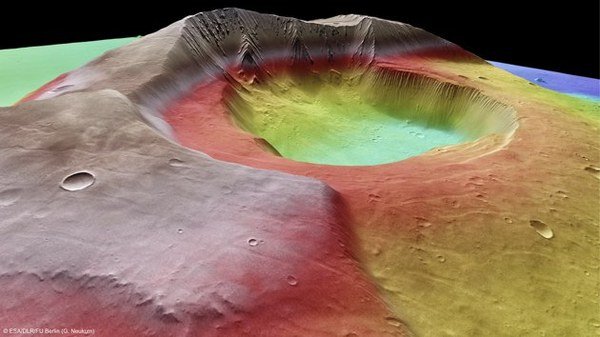
The European Space Agency recently released stunning images of one of the planet's most striking features: the Tharsis Tholus volcano.
The area surrounding the mountainous landmark is relatively bare, causing the huge Martian structure to stand out. When active, Tharsis Tholus was likely much larger than it is today. Image Credit: ESA/DLR/FU Berlin (G. Neukum). Photo courtesy of Tecca
The planet Mars is a bit of an obsession for the human race. We've romanticized the red planet in everything from movies to video games, and we can't seem to get enough of the barren, desert-like planet. The European Space Agency isn't immune to Mars lust, and the organization recently released some stunning images of one of the planet's most striking features: the Tharsis Tholus volcano. Presented with false color to highlight its geographical features, the once-lively mountain is still a sight to behold. Join us as we take a tour of a true Martian landmark. Image Credit: ESA/DLR/FU Berlin (G. Neukum). Photo courtesy of Tecca
The Tharsis Tholis volcano stands 5 miles tall on the rocky Martian landscape, dwarfing the tallest volcanoes on Earth. Ojos del Salado on the Argentina-Chile border comes closest, measuring 4.2 miles tall. Image Credit: ESA/DLR/FU Berlin (G. Neukum). Photo courtesy of Tecca
 The expansive crater located in the center of the volcano resulted from the loss of supportive magma that the mountain spewed billions of years ago. With the interior of the volcano lost, its roof caved in, forming the giant hole we see today. Image Credit: ESA/DLR/FU Berlin (G. Neukum). Photo courtesy of Tecca
Over the course of billions of years, Tharsis Tholus has become dotted with the scars of small to medium-sized impacts from space debris. The mountain is in an advanced state of erosion, making it particularly interesting to scientists looking to study the history of the red planet. Image Credit: ESA/DLR/FU Berlin (G. Neukum). Photo courtesy of Tecca
 Tharsis Tholus' large size is aided by the relatively low gravity of Mars. With less than half of the gravitational force of Earth, it is easier for huge geographical features to exist on the Martian landscape. Image Credit: ESA/DLR/FU Berlin (G. Neukum). Photo courtesy of Tecca
»»  read more

5 Nov 2011

Mars Rover Discovers 'A Completely New Thing'

 While looking for a safe place to weather the cold Martian winter, the rover Opportunity spied a subtle yet intriguing feature on the edge of the giant Endeavour crater: a bright vein of light-toned rock piercing the ruddy, rocky surface of a large rise called Cape York.

Seen above running horizontally at center, in an image colored by Stuart Atkinson, the vein (dubbed "Homestake") may prove to be hard evidence of phyllosilicates -- minerals formed in the presence of a watery environment. If this is the case then this chance discovery would mean that Opportunity, after nearly eight years on Mars, has literally stumbled upon the "Holy Grail" of its entire mission!
Data from the Mars Reconnaissance Orbiter has already identified the region around Endeavour Crater as containing phyllosilicates, specifically iron- and magnesium-rich clays known as "smectites". These minerals are sure signs of past water... most likely salty water that could have been highly conducive to the development of life.
Identifying chemical signatures from orbit is one thing, though... finding and studying actual outcroppings of phyllosilicates at ground level is something else entirely. And this is precisely what the MER team has been hoping Opportunity will do at Endeavour.
"This is a real triumph of geology," said Steve Squyres, Mars Exploration Rover principal investigator at Cornell University. "We saw these veins as we crossed from the Meridiani plains into the Noachian terrain back in August. We've kept those in mind as a very important thing we wanted to look at, but we were so focused on getting into the Noachian and new terrain that we made that the highest priority, figuring that we would get the veins later."
It looks like "later" is now.
A closer look at Homestake with Opportunity's microscopic camera shows a bright surface gouged by linear scratches. This view, a composite of three separate images also by Stu Atkinson, gives a closer look:
The MER team hasn't officially stated what they believe the vein may be composed of but they definitely sound intrigued.
"These are different than anything from anything we've ever seen with either rover, a completely new thing on Mars, never seen anywhere," Squyres said. "And we're pretty charged up about it."
In the meantime the rest of us will have to wait for further information.
Opportunity is now facing its fifth Martian winter and the MER team must soon plan driving maneuvers to place it at a prime location to weather the long months of frigid temperatures and reduced sunlight. Most importantly it will need to find a north-facing slope that will position it at a ten- to fifteen-degree angle, to take best advantage of the available sunlight on its already dusty solar panels. While this potential discovery is undoubtedly exciting, Opportunity's ultimate survival must take precedence.
Once the six-month-long Martian winter is over, Opportunity can resume exploration of the area around Cape York, an area that has already proven itself to hold promises of many never-before-seen features.
"All the rocks we're seeing here are completely different than Opportunity has ever seen and different significantly than the rocks Spirit saw as well," said Bruce Banerdt, MER project scientist at JPL. "So we're already picking up new geology and new rocks and new petrology that no one's ever encountered yet on the Martian surface. It's all great stuff. There is a lot of activity going on and the science team is really jazzed right now."
Find out more in the Mars Exploration Rover 2011 Update on The Planetary Society blog, and keep up with Opportunity's progress on Stu Atkinson's blog The Road to Endeavour.
Image credits: NASA/JPL-Caltech. Edited by Stu Atkinson.
»»  read more

20 Jun 2011

Face of Gandhi Found On Google Mars

A Martian surface feature that one man says looks like the profile of Mahatma Gandhi.
CREDIT: Matteo Ianneo/ESA/Google Maps/Before It's News
Now that Google Mars, a new online map pieced together from satellite images of the Red Planet, is up and running, space enthusiasts the world over are finding interesting objects on the Martian surface.
The latest is a face found by an Italian named Matteo Ianneo, who has also claimed to have found vegetation, entrances to underground tunnels, and city ruins on Mars in the past few weeks. Ianneo says his latest surface find, which is located at 33°12'29.82"N, 12°55'51.21"W, looks like a picture of Mahatma Gandhi in profile.
It is reminiscent of the Face on Mars, a hill photographed by NASA's Viking 1 probe in 1976 that, in one low-resolution image, resembled a face.  Within days of its discovery, space hobbyists were speculating that the structure was man-made and had been built by ancient Martians. A higher-resolution image taken of the "face" last year by NASA's HiRISE camera revealed a rugged hill.
Seeing things
"Pareidolia" is the scientific term for seeing faces (or other significant objects) where they aren't. Face pareidolia happens, scientists say, as a byproduct of our heightened sensitivity to the details of human faces. Takeo Watanabe of the Boston University Visual Sciences Laboratory put it this way: "We've over-learned human faces so we see them where they aren't."
Last week, a self-described "armchair astronaut" discovered another anomaly while perusing the Google Mars map.  In a viral Youtube video, David Martines claimed to have identified a human (or alien) base on the planet, which he dubbed Bio Station Alpha. The somewhat mysterious linear streak that he thought was a building on the Martian surface was later revealed to be a cosmic ray artifact — a distortion arising in the camera that snapped the photo of the surface when an energetic particle zipped through it.
People have been finding suggestive objects on the surface of Mars for centuries. By making our neighboring planet visible to everyone, Google Mars will likely increase the frequency of such finds.
CREDIT: Life's Little Mysteries
»»  read more
Related Posts .