Showing posts with label Science Top 10. Show all posts

28 Nov 2011

Top 10 Space Weapons (Gallery)

MISILLE
The ability to destroy man-made satellites in orbit around Earth has already been demonstrated by China, who used an anti-satellite (ASAT) device against one of their own weather satellites. The US likewise shot down a crippled spy satellite in 2008 with a sea-based missile. India has said they wish to develop similar capabilities. The problem: Huge swarms of space debris generated by blowing up objects remain in orbit, and threaten manned spacecraft.
DARPA
Does a device that uses electromagnets to shoot a stream of molten metal at incredible speed toward enemy targets sound far-fetched? The Defense Advanced Research Projects Agency (DARPA) is already working on one, with the appropriately aggressive-sounding name of "MAHEM" (Magneto Hydrodynamic Explosive Munition). Pictured is Earthlight, an Arthur C. Clarke novel that presaged exactly this device.
DARPA looks to use electromagnets to shoot molten metal at enemy targets. The futuristic military weapon is called “MAHEM”
THEL
Directed-energy weapons utilize lasers, high-powered microwaves, and particle beams. Projects in development by the US have names like Airborne Laser, the Active Denial System, and the Tactical High Energy Laser (THEL). However, before these weapons can "stun" or "kill" like a Star Trek phaser, engineers need to do much work to weaponize the various forms of energy under consideration.
Energy weapons such as lasers, high-powered microwaves and particle beams are in development by the US.
Cosmic Satellites
Home-grown microsatellite and nanosatellite technologies are being proliferated by a number of nations, hinting at some military uses. In one U.S, Department of Defense report, military officials took at face value a Hong Kong newspaper account in January 2001 that claimed China had developed and tested an ASAT system using a "parasitic microsatellite." Apparently this device could have been a small satellite designed to attach itself to other satellites to destroy or damage them. This sexy but unsubstantiated assertion quietly vanished from further DoD reports.
Microsatellite & Nanosatellite technology could be used as an anti-satellite (ASAT) device to cripple or destroy other satellites.
Soviet Union’s Almaz Space Station
Weapons in space need not be so exotic. Take the former Soviet Union's Almaz Space Station of the 1960s and '70s. The military space station reportedly carried a cannon to destroy satellites or incoming spacecraft. It was even reportedly tested (while no one was aboard the spacecraft) to demonstrate its feasibility. Other space-based conventional weapons could include more exotic packages of destruction, such as radio-frequency or high-power-microwave munitions.
The Soviet Union’s Almaz Space Station carried a cannon, space based conventional weapons could include exotic weapons such as high power microwave munitions.
MOL
In the USAF's Manned Orbital Laboratory (MOL) program of 1965, two astronauts would launch atop a Titan 3 rocket in a spacecraft similar to NASA's Gemini capsules, then conduct reconnaissance missions from orbit using ultra high-resolution telescopes. The project was scuttled in 1969, and unmanned spy satellites proved a better option later.
USAF’s Manned Orbital Laboratory (MOL) was stopped since unmanned spy satellites were a better option.
ICBM
Deploying nuclear bombs in outer space seems like a natural goal of the military. Indeed, in the 1950's the US Air Force planned to detonate a nuclear bomb on the moon. This effort, dubbed Project A 119, included a young Carl Sagan on its team. At the time, an intercontinental ballistic missile (ICBM) carrying a nuclear warhead possessed the capability to reach the moon. Fortunately, the man in the moon was spared.
X-37B Orbital Test Vehicle (OTV)
Scheduled for a test flight on April 20, 2010, the reusable robotic X-37B Orbital Test Vehicle (OTV) is a small space shuttle-like craft developed by the US Air Force. If such a reusable space plane becomes feasible, it will offer unheard-of capabilities for launch on-demand, surprise, and flexibility. If those benefits aren't enough, the space plane may be outfitted with a weapon to drop tungsten rods on Earth targets from outer space, the so-called "Rods from God."
High-altitude Weapons
High-altitude weapons using electromagnetic energy may destroy and disrupt electronic and electrical devices, causing a burst of electromagnetic radiation (electromagnetic pulse, or EMP) to produce current and voltage surges. These bursts are commonly associated with nuclear explosions, but scientists have produced non-nuclear EMP's. The construction of small "e-bombs" poses a significant terrorist threat against airplanes.
High-altitude weapons would use electromagnetic radiation (EMP) to produce current & voltage surges. These “e-bombs” can pose a threat to airplanes.
Manipulating an orbiting asteroid
Could an orbiting asteroid be manipulated to smash down on an enemy target on Earth? It's possible, but doesn't seem like an efficient way of doing battle, according to a RAND think-tank report. More effort would be required to achieve such a result than was employed to develop the first A-bomb during the Manhattan Project in WWII, says RAND.
Source: LiveScience
-----------------------------
»»  read more

15 Oct 2011

10 Amazing Animals that Use Camouflage

The animal kingdom is a wild, wacky place where animals have to be clever in order to survive. One of the most amazing techniques for survival is animal camouflage. Animals have the ability to mimic plants, ground cover, or even other animals in order to hide or hunt. The following is a list of some animals that are particularly gifted in the art of invisibility.
1. Chameleons
Contrary to popular belief, chameleons only change color when in imminent danger. Their everyday skin color, a light khaki, keeps them hidden from enemies during those not-so-dangerous times. Nearly half the world's chameleon species live in Madagascar, but they're also found in Africa, the Middle East, and southern Europe.
2. Leopards
Whether their coats are spo­tted (useful for hiding in sun-dappled areas in the African outback) or black (perfect for nighttime stalking or lurking in shadows), these elegant and deadly cats are born with fashionable camouflage. Rabbits, young buffalo, and monkeys don't stand a chance when a hidden leopard makes a surprise attack.
3. Polar Bears
Other bears and human poachers are the biggest threats to the majestic polar bear, but by blending into the blindingly white snow of the Arctic with equally white fur coats, some danger can be avoided. Only a polar bear's nose and foot pads are without fur.
4. Turtles
If you're a fish, you better look twice before resting near that big rock . . . it could be an snapping turtle. There are hundreds of species of turtles and tortoises that use camouflage to blindside their prey and hide from large predators like alligators. Sadly, camouflage can't protect turtles from the poacher's fishnet.
Sure, chameleons are well-known to change color and blend into surroundings, but some of the animals who use camouflage on the next few pages may surprise you.
5. Arctic Owls
Ah, the Arctic tundra: cold, barren, and totally white. Arctic owls have a coat of snow-white feathers to keep them warm and safe from predators, such as foxes and wolves.
6. Bark Bugs
For most bugs, birds are the bad guys. For bark bugs, which hang out on trees around the world, this is especially true. In order to hide in the middle of nature's birdhouses, bark bugs appear to be part of the tree itself.
7. Gaboon Vipers
In order to hide from their prey, gaboon vipers -- among the most venomous snakes on Earth -- make the most of their brownish-gray, mottled scales. These big snakes hide in the layer of dead leaves that carpets the African rain forest floors. They also like to snuggle into forest floor peat and sneak up on unsuspecting prey.
8. Leaf Butterflies
Complete with fake leaf stalk, fake leaf veins, and perfect dead-leaf coloring, leaf butterflies have the whole camouflage thing down pat. Birds pass them by without a second glance since these insects from southeast Asia look more like dead leaves than butterflies.
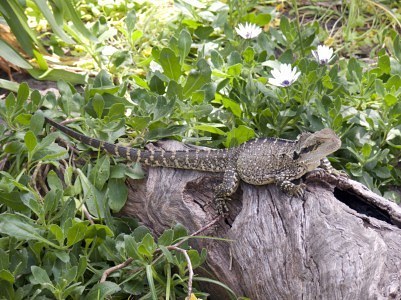
9. Dragon Lizards
Spiders, snakes, birds, and even other lizards all want a piece of the dragon lizard, so they have some of the most effective camouflage around. Not only do dragon lizards look nearly invisible when hanging out on a tree branch, they keep extraordinarily still, knowing that their predators react to the smallest movements. It doesn't make for an exciting life, but at least they live to tell about it.
10. Flower Mantises
Careful-- that flower you're thinking about smelling might have a flower mantis hiding inside. The flower mantis of western Africa uses colorful, pistil-and-stamen-like camouflage to trick smaller insects into smelling the roses, then snap -- lunch is served.
(Story Source:Editors of Publications International, Ltd.)
»»  read more

16 Sept 2011

TOP 10 Glowing Sea Creatures

Queen Angelfish
Credit: Brandi Irwin, Liquid Film Photography
Photographer Brandi Irwin uses special lighting on night dives to capture otherworldly photos of sea creatures that fluoresce, including fish, coral and sea slugs.
Red and Green
Credit: Brandi Irwin, Liquid Film Photography
A light similar to a black light plus a special camera filter bring out colors not visible to the naked eye.

Glowing Coral
Credit: Brandi Irwin, Liquid Film Photography
Many of Irwin's photos are taken in the Caribbean, but she is planning a dive trip in Asian waters this fall.
Anemone Dance
Credit: Brandi Irwin, Liquid Film Photography
The fluorescing anemones are among the stars of a New York Aquarium show, opening August 5, of Irwin's work.
All coiled up
Credit: Brandi Irwin, Liquid Film Photography
An octopus peers out from the tangle of its legs. "I will come to the surface with whatever the ocean gives me," Irwin told LiveScience. "It's unpredictable down there."

Frilly Slug 

Credit: Brandi Irwin, Liquid Film Photography
A lettuce sea slug.

Bristle Worm
Credit: Brandi Irwin, Liquid Film Photography
A bristle worm glows green. Irwin's dives take place on moonlit nights.

Seahorse Meeting 

Credit: Brandi Irwin, Liquid Film Photography
Two seahorses photographed by Irwin.

Stingray 
Credit: Brandi Irwin, Liquid Film Photography
Sometimes black and white is more striking. Here, a stingray approaches a shipwreck.
Sunflowers of the Deep
 
Credit: Brandi Irwin, Liquid Film Photography
And sometimes the colors are riotous, as with these sunflower-like anemones.
»»  read more

8 Sept 2011

SC/Top 10 Extinct Animals

No. 10 - Passenger Pigeon
The earliest settlers in the New World were amazed by the passenger pigeon, a bird with flocks so huge that it would take days for them to travel overhead, blackening the sky as they passed. Any farmer who had the misfortune of hosting passenger pigeons for a meal would quickly find his entire crop decimated within the blink of an eye. Then, virtually overnight, the most abundant bird in North America suddenly disappeared from the planet.
The extinction of the passenger pigeon is an example of nature coming into direct conflict with man. Its population numbered an astounding 3 to 5 billion when the first Europeans arrived in America. However, there was not room enough in the New World for both species. Passenger pigeons were soon wiped out due to merciless hunting, deforestation and other factors related to humankind's ever-expanding range. The extinction was only becoming apparent at the start of the 20th century; by 1914, the last known bird was dead.
No. 9 - Quagga
The quagga is a mammal closely related to modern horses and zebras. In fact, it looks like a cross between a horse and a zebra, with stripes only on its head and neck that disappear as they approach the brownish hindquarters of the animal. The quagga was native to desert areas of South Africa until it was hunted to extinction in the 1870s. The last captive animals died in Europe in the 1880s.
As an extinct species, the quagga has a couple claims to fame. For starters, it was the first animal to have its DNA analyzed, which led to the discovery that the quagga was not a distinct species but a subspecies of the plains zebra. Also, the quagga is the subject of an ambitious breeding effort by the aptly named Quagga Project, the result of which was a foal born in 2005. Based on appearances, the "re-created" quagga closely resembles the ancient quagga, but DNA evidence has yet to determine whether this animal is authentic.
No. 8 - Archaeopteryx
Holding the No.8 spot in our countdown is an ancient creature named Archaeopteryx, whose discovery in the mid-1800s turned the world of paleontology upside down. It looked like some sort of feathered dinosaur, but it also had a number of bird characteristics. Was it a bird, a dinosaur or some other beast entirely? Clues would come in time, but only after decades of contentious debate and close examination.
In order to fully understand the natural history of Archaeopteryx, one needs first to take a look at some of its unusual characteristics. Its dinosaur features include a full set of teeth, a flat breastbone, a bone tail and claws on the end of its wing. On the other hand, its feathers and wings also made it quite birdlike. However, details of Archaeopteryx anatomy indicated that it was not ideally built for flight and probably spent as much time running, leaping, climbing and gliding as it did flying.
So what was this enigmatic animal? It is now widely believed that Archaeopteryx is the most primitive known bird, with several specimens dating back about 150 million years to the Jurassic Period. It is also an evolutionary link between modern birds and a group of dinosaurs that roamed the earth 150 million years ago. Thus, it is one of the most important fossil species ever found. 
No. 7 - Saber-Toothed Cat
Of all the cute, cuddly animals found in the fossil record, the saber-toothed cat (also called the saber-toothed tiger) is one of the last you would want to meet in a dark alley. With their daggerlike canine teeth and powerful bodies, this animal was one of the most ferocious predators of the Cenozoic Period. It lived in North America and Europe and went extinct about 10,000 years ago. There have been several thousand saber-toothed cat specimens found at the famous La Brea Tar Pits in Los Angeles, Calif. – so many that it was named the state fossil of California.
So, what were these big beasts like in the wild? Evidence suggests that the saber-toothed cat had a social structure much like modern lions, living together and cooperating in order to bring down prey. Interestingly, researchers also believe that a certain amount of nurturing went on in a saber-toothed cat pack. Many individual fossils show signs of extensive regeneration and healing after disease and injury, suggesting an environment in which individuals could be cared for by other members of the group. Despite their terrifying appearance, it seems these animals had a soft side.
No. 6 - Plesiosaur
No collection of the top 10 extinct animals would be complete without the enigmatic plesiosaur, a large aquatic reptile that swam in the world's oceans during the Jurassic and Cretaceous periods. There are several different species of plesiosaur, but the most famous are the ones with a very long neck topped by a tiny head. Most of these animals were astonishingly large, sometimes reaching a whopping 65 feet in length.
Many people believe strongly in a connection between the plesiosaur and the Loch Ness Monster, a legendary creature that some say inhabits the waters of Loch Ness in Scotland. Indeed, some believe that the appearance of the Loch Ness Monster is evidence of a living plesiosaur. However, according to the fossil record, plesiosaurs disappeared at the end of the Cretaceous Period, about 65 million years ago. And contrary to popular belief, they were not dinosaurs, despite the fact that both groups lived and died off at the same time.
No. 5 - Hallucigenia
No. 5 on our countdown dates back more than 500 million years to a time known as the Cambrian Period when most of the major groups of animals first appeared. The Cambrian Period was also a time of evolutionary experimentation in which countless bizarre body plans were tried out and then left behind in the primordial soup. One particularly odd set of fossils come from an area of the Canadian Rockies known as the Burgess Shale, including a strange little arthropod named Hallucigenia.
Hallucigenia gets its name from its body plan, which appears to have been designed by someone under the influence of psychedelic drugs. It has an elongated body with a row of tentacles on one side and a string of stiltlike spines on the other. At first, researchers had no idea which way to orient the animal — on its tentacles or on its spines — but chose the spines since the tentacles appeared to have mouthparts on the end of them. However, recent evidence suggests that Hallucigenia's tentacles were actually paired appendages used for walking and that the spines were most likely for protection from predators. Based on this discovery, Hallucigenia was finally turned right side up.
No. 4 - The Dodo
Contrary to popular belief, the dodo was not a stupid or lazy bird. After all, it lived in a predator-free environment where food was plentiful on the ground. Why bother flying when you can simply stroll about at a leisurely pace? But what was by all accounts the sweet life for the dodo came to an abrupt end in the1600s, when European explorers landed on Mauritius, the island in the Indian Ocean where the dodo made its home. After their arrival, it would be only a few short years before the animal was hunted to extinction, primarily because it was a much-needed source of meat for weary sailors. In addition, the pigs, dogs and rats that inevitably accompanied sailing ships made short work of dodo eggs, which were all too accessible from their nests on the ground. The dodo never stood a chance. 
No. 3 - Woolly Mammoth
If there is one animal most associated with the Ice Age, it has to be the woolly mammoth, that giant shaggy beast with long ivory tusks curling up from its massive trunk-like nose. The woolly mammoth was one of several species of mammoth, the earliest of which were probably small and amphibious creatures living in North Africa until about three million years ago. Their descendants eventually dispersed throughout Eurasia and the woolly mammoth, one of the smaller mammoth species, migrated to North America across the Bering Land Bridge sometime during late Pleistocene. Alas, this enigmatic creature did not survive long in the New World. The last of the woolly mammoths died out at the end of the last ice age, about ten thousand years ago.
No. 2 - Flores Man
When researchers stumbled onto remains of what appeared to be a group of mini-humans in an Indonesian cave in 2003, they could hardly conceive of the significance of their find. There were several individuals, each of which had tiny heads and were about 3 feet tall. Did these creatures represent a new species of hominid, some sort of advanced ape or were they merely humans with a medical condition that would account for their diminutive size? The debate rages on, but recent evidence suggests that they may represent a distinct line in human evolution.
Nicknamed "Hobbits," these tiny primates were eventually named "Flores man" for the Indonesian island on which they were found. The last of them appear to have died out about 12,000 years ago. Incredibly, this means that Flores man overlapped with modern man for centuries, living in caves and using tools much like primitive humans. Did Flores man encounter modern man and, if so, what was their interaction like? We may never know the truth, but we now have a great mystery to ponder.
No. 1 - Tyrannosaurus Rex
Topping our countdown at No. 1, Tyrannosaurus Rex is an animal whose fossil remains are known to school children and adults from all parts of the world as the most fearsome predator that ever walked the planet. Standing about 40 feet in length, with a massive head and jaws that could have eaten an adult man in a single bite, one look at the remains of this brutish beast sends chills down the spine of anyone considering time travel to the Cretaceous Period.
So, if Tyrannosaurus Rex and the other dinosaurs were so ferocious, why did they die out? This is one of paleontology's great mysteries, but evidence from the fossil record suggests that
there may have been a catastrophic event such as a meteor impact or volcanic eruption that killed off dinosaurs and most other living things on the planet at the time.
One thing is certain about dinosaurs in general and Tyrannosaurus Rex in particular: no other group of extinct animals has captivated humans quite so much. Perhaps it's not so much the animals themselves that command our attention but the idea that such a catastrophe could cause humans to suffer a similar fate. Then, millions of years later, a future life form might be sitting around a table wondering what wiped out such a seemingly well-established creature as Homo sapiens.


»»  read more

2 Sept 2011

10 Amazing Albino Animals

Albinism is defined by a lack of pigmentation in the skin, eyes and hair. Depending on the animal, albinism expresses itself to varying degrees, such as the albino python, which has yellow patterns instead of the standard brown. Animals that are unusually snowy-white but do not have red eyes are not albino, however. A different, rare genetic disorder known as leucism causes reduction in pigmentation in the skin and hair, but does not affect eye color.
_______________________________________________
10. Kangaroo 
Credit: nitram0864 | flickr
Unlike the kangaroo's usual dark caramel or gray fur color, those born as albinos have white fur and pink eyes, paws and muzzles.
_______________________________________________
09. Squirrel 
Credit: Andrea Browning
Albino squirrels are quite popular in some parts of the United States. Olney, Ill., is one of the towns that calls itself "Home of the White Squirrels," along with Marionville, Mo., and Brevard, N.C. The township of Kenton, Tenn., proudly boasts a population of 200 of the furry, pale rodents.
_______________________________________________
08.Deer 
Credit: Mike Lewis | pescatello - flickr  
A lack of pigmentation in the irises of albino animals' eyes causes blood vessels to show through, giving them their crimson hue, such as the case with this tiny fawn. Approximately one in every 30,000 deer births is albino.
_______________________________________________
07. Alligator 
Credit: Mila Zinkova 
Because they are so pale, albino alligators can get a pink sunburn from being out in direct sunlight for too long. To accommodate them, zoos such as the Knoxville Zoo in Knoxville, Tenn., create heavily shaded habitats with special heat lamps for the pigment-challenged alligators
_______________________________________________
06. Skunks 
Credit: jenni-skunks | flickr 
These skunks look much less menacing without their trademark black and white stripes, but their scent glands are just as stinky as their normal counterparts.
_______________________________________________
05.Albino pythons
Albino pythons have light yellow patterns on their pale, pinkish-white skin instead of the standard brown and tan designs.
_______________________________________________
04.Hedgehog
Credit: deniscarl.com 
Only one in 10,000 hedgehogs is born albino, with red eyes. Although it seems as though the creamy hue of their spines would make it difficult for them to hide from predators, hedgehogs in the wild often rummage through dirt, which aides in camouflaging their bodies.
_______________________________________________
03. Eastern Screech Owl 
Credit: Jon P. Inghram
Screech owls normally range in color from gray to rusty brown, with distinct, buttercup-yellow irises. Albino owls, however, have pink skin around their eyes, whose color can range from pink to a dark cherry-red. Pink toes are another indicator of albinism in owls. (Snowy owls are often confused with albino owls, but snowy owls have black specks on their lower bodies and golden eyes that are ringed with black skin.)
_______________________________________________
02. Chipmunk
Credit: Kevin James | k.d.james | flickr 
Rather than having the characteristic black-and-white stripes running down their tawny bodies, albino chipmunks are white with pale butterscotch stripes. This albino chipmunk was photographed at Noah's Ark Zoo Farm in North Somerset, United Kingdom, in June 2011.
_______________________________________________
01. Albino Iguana 
Credit: Mgkuijpers | Dreamstime 
Similar to albino pythons, albino iguanas have light yellow coloring over their light pink skin. Though albino animals are not usually blind, as one myth puts forth, the lack of pigmentation in their eyes allows light to penetrate directly through the structures of the eye rather than only pass through the pupil. This can lead to vision problems over time, but does not cause them to completely lose their eyesight.
_______________________________________________
»»  read more
Related Posts .